ES
 DE
 FR
 IT



GDP is growing, but production remains a challenge for industry
The growth of the Italian economy coexists with difficulties in the industrial sector. In this scenario, taking care of plants and electronics becomes a concrete choice to protect production continuity.
GDP is growing. Good news, but on its own it doesn’t tell what is happening inside factories.
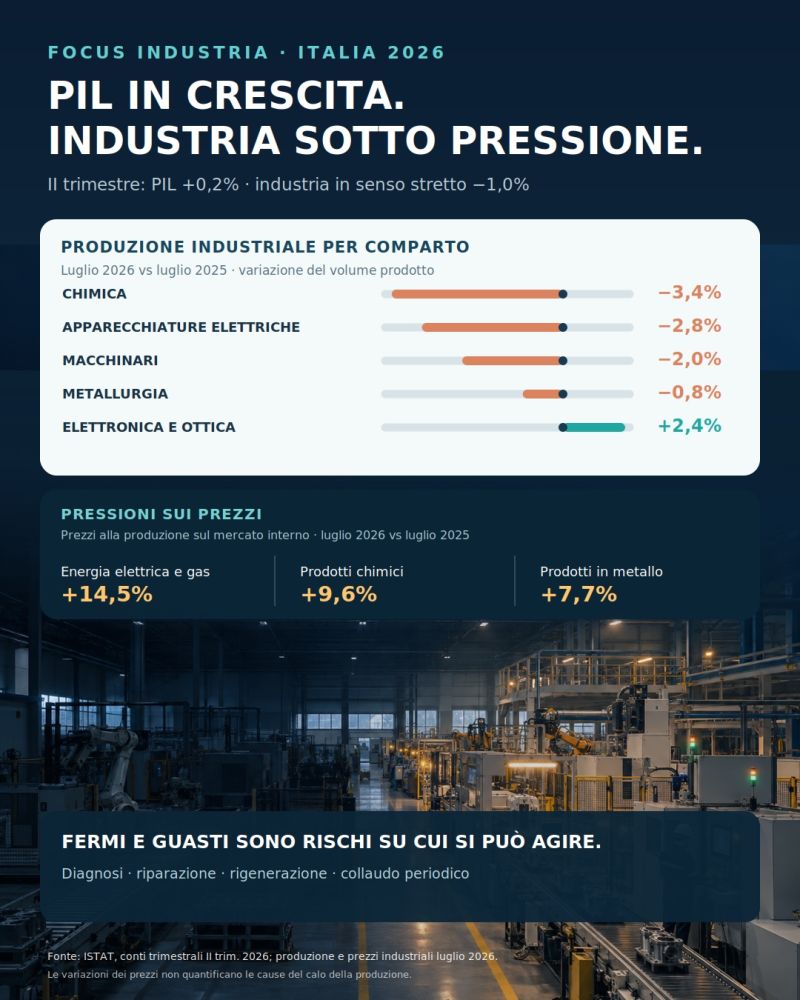
According to ISTAT’s quarterly national accounts, updated with the revision of 5 October, Italian GDP increased in the second quarter of 2026 by 0.2% compared with the previous quarter. Over the same period, value added in services grew by 0.4%, while that of industry fell by 0.6%.
The economy, therefore, is not moving at the same pace everywhere. For an industrial company, overall national growth can go hand in hand with production activity that is harder to manage.
Costs and uncertainty put pressure on production
The international picture adds complexity to business decisions. The Bank of Italy’s Economic Bulletin No. 3/2026 highlights tensions on energy markets, geopolitical uncertainty and risks to supply chains: factors that can affect costs, trade and planning.
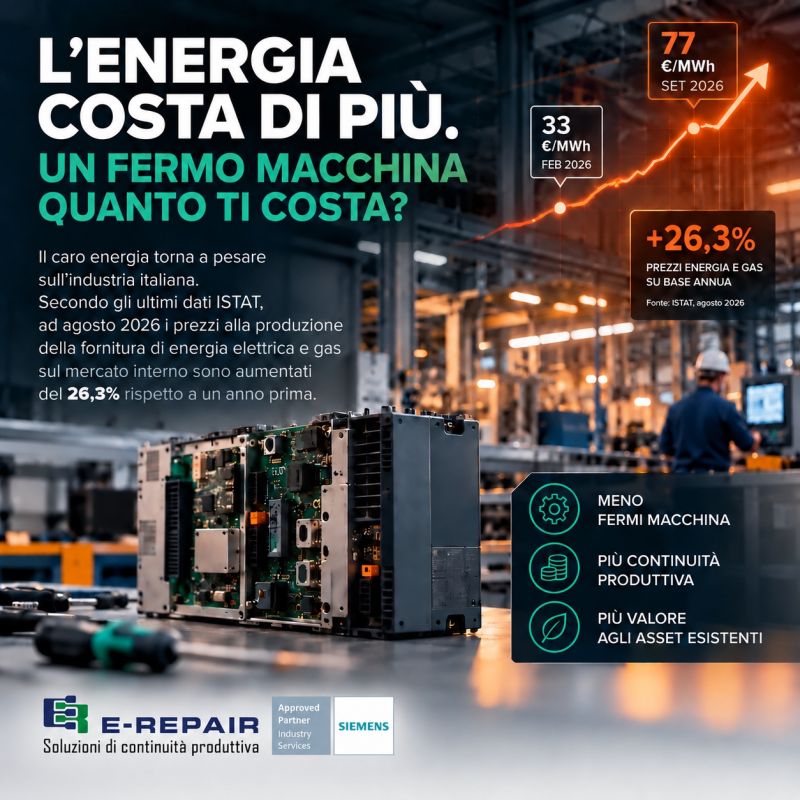
Producer prices are also showing signs of pressure. In July 2026, according to ISTAT, industrial producer prices rose by 7.8% year on year. On the domestic market, excluding energy, the annual increase was 3.3%.
These indicators describe the prices charged by producers and do not automatically match the cost increase of each individual company. However, they help to understand the context in which companies buy, produce and set their commercial terms.
When costs and lead times become less predictable, organising production well becomes even more valuable.
A failure can cost more than the component
In this scenario, an unplanned interruption can add difficulty to an already complex situation.
A faulty control board, power supply or drive can stop a machine from running. At that point, the problem goes beyond the repair: lost production must be managed, activities reorganised and a solution found that fits the company’s timescales.
If the spare part is not available, the wait can get longer. If it is in stock but has not been tested, the restart may hit another obstacle.
The cost of a component matters. So does how much the plant depends on it working.
Knowing your plants to prepare interventions
A single company cannot control energy market trends or international uncertainty. But it can improve its knowledge of its own plants and organise the management of critical components.
A first step is to answer a few questions:
-
Which electronic components can stop a machine or a line?
-
Are there recurring anomalies that deserve a diagnosis?
-
Are the available spare parts compatible and working?
-
For which equipment is it advisable to plan a check or an intervention?
The answers help set priorities and prepare the necessary actions. Prevention does not eliminate every failure, but it can help reduce the unexpected and make the response more organised.
Spare parts in stock must be ready to work
A spare part is a valuable resource when it can be used when needed.
Being on the shelf does not, on its own, confirm that it works. The history of the device and its storage conditions should be taken into account, especially for electronics that have been unused for a long time.
Periodic testing makes it possible to check its operation under the test conditions and to detect any anomalies before use.
Testing spare parts therefore means making a resource the company relies on to restart more dependable.
Repair and remanufacture to make the most of existing assets
When technical conditions allow, repair and remanufacturing can restore the functionality of industrial electronics and help extend their service life.
The choice must start from an assessment: condition of the device, nature of the fault, availability of components and needs of the plant.
Making the most of what is already available means identifying where recovery is technically appropriate and useful for production. In this way, the company can decide more consciously how to use its resources.
E‑Repair’s contribution to production continuity
E‑Repair supports companies with diagnosis, component-level repair, remanufacturing and testing services for industrial electronics.
From assessing a faulty device to testing spare parts in stock, we work to help companies keep the resources their plants need available and working.
When producing becomes harder, every component ready to work counts.
Contact E‑Repair to assess the condition of your industrial electronics and plan the interventions best suited to your production needs.
Sources and further reading: