ES
 DE
 FR
 IT









Machine tools 2026: recovery and industrial maintenance
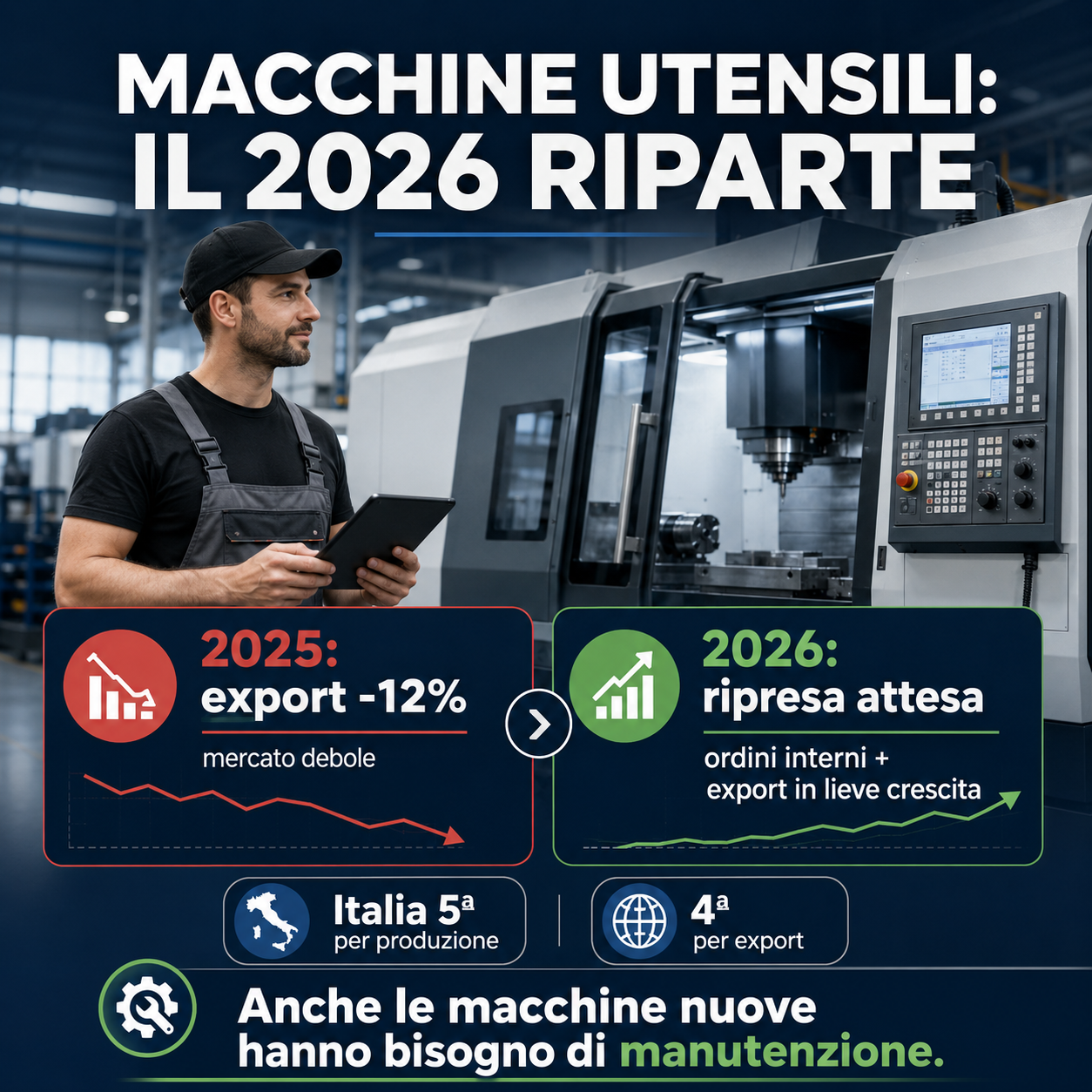
📈 After a 2025 marked by a sharp fall in exports, the Italian machine tool, robotics and automation industry is looking to 2026 with greater confidence.
The forecasts presented at the members’ meeting of UCIMU – SISTEMI PER PRODURRE point to a still moderate recovery, driven mainly by the domestic market and the restart of industrial investment.
A possible rise in orders and the full roll-out of the Iperammortamento (Italy’s hyper-depreciation incentive) could help renew the technology of Italy’s production system.
But buying new machines is only the first step.
The more digitalised, automated and interconnected plants become, the more necessary it is to plan their maintenance from the outset, protect their data and put in place strategies to ensure their long-term reliability. ⚙️
Machine tools: the 2025 results
According to data compiled by the UCIMU Centro Studi & Cultura di Impresa, in 2025 Italian production of machine tools, robots and automation systems reached €6.391 billion, up 1% on 2024.
The overall picture, however, was heavily affected by weak foreign markets.
Exports fell by 12% to €3.760 billion.
The export-to-production ratio thus fell from 67.5% in 2024 to 58.8% in 2025.
The decline affected some of the main destination markets for Italian technology:
🔹 United States: -9%
🔹 Germany: -24.9%
🔹 Turkey: -11.5%
🔹 India: -11.6%
🔹 Mexico: -10%
🔹 China: -54.1%
Total sector turnover stood at €9.330 billion.
2025 therefore showed two different trends: very weak international demand and, at the same time, a strong recovery in the domestic market. 🌍
The domestic market is supporting investment again
After two years of decline, deliveries by Italian manufacturers to the domestic market grew again in 2025.
Sales to Italian companies reached €2.631 billion, up 28.1% on the previous year.
Domestic consumption also rose by 22.3% to €4.534 billion.
These are positive signs, although the figures are still some way off the levels reached in 2021-2022.
Growth in the domestic market nonetheless shows that many companies are once again considering investments aimed at:
-
replacing obsolete machines;
-
increasing production capacity;
-
introducing more highly automated systems;
-
improving energy efficiency;
-
interconnecting machines, departments and management systems;
-
increasing production flexibility, quality and traceability.
Renewing the installed machine base could therefore become one of the key elements of Italian manufacturing competitiveness in the coming years. 🏭
Italy among the world leaders in machine tools
Despite the slowdown in exports, the Italian machine tool industry continues to hold a leading position internationally.
Italy has confirmed its position as:
🏅 fifth in the world for machine tool production;
🏅 fifth in the world for consumption;
🏅 fourth in the world for exports.
These results reflect Italy’s top-level industrial, technological and engineering expertise.
The ability to build and integrate machine tools, robots and automation systems is in fact a strategic asset not only for manufacturers in the sector, but for the entire manufacturing system.
Machine tools underpin the automotive, aerospace, mechanical engineering, energy, packaging, pharmaceutical and chemical supply chains, and many other essential sectors of the economy. 🇮🇹
UCIMU forecasts for 2026
For 2026, UCIMU expects the main indicators to return to positive territory, albeit with still modest increases. 📊
Italian production is expected to reach €6.640 billion, up 3.9%.
Exports are expected to remain broadly stable at €3.785 billion, with growth limited to 0.7%.
Once again, the domestic market should be more dynamic:
-
deliveries by Italian manufacturers are expected to rise by 8.5% to €2.855 billion;
-
Italian demand is expected to grow by 7.4% to €4.870 billion;
-
imports are forecast to rise by 5.9%.
The recovery should therefore be driven mainly by investment by Italian companies, while activity on international markets will continue to suffer from a complex geopolitical and economic scenario.
The role of the Iperammortamento in the investment recovery
A large part of the expectations for 2026 is linked to the effect of the Iperammortamento (Italian hyper-depreciation), which could help unlock investments put on hold during the first months of the year.
Incentives can speed up the purchase of new machinery and technologies, but investment decisions should not be based solely on the tax advantage.
To generate a lasting industrial benefit, a new machine must be part of a strategy that takes into account:
-
production capacity;
-
energy consumption;
-
spare parts availability;
-
staff skills;
-
digital integration;
-
cybersecurity;
-
planned maintenance;
-
management of electronic obsolescence;
-
recovery times in the event of failure.
The real return on investment therefore depends not only on the machine’s initial performance, but on its ability to keep producing reliably throughout its entire life cycle. 💡
New machines need maintenance too
Buying a new machine is often associated with the idea that, at least in the first few years, no particular maintenance is needed.
In reality, even a new-generation machine requires a proper maintenance strategy from the very beginning.
Modern production systems integrate numerous electronic and digital components:
-
drives and inverters;
-
numerical controls;
-
PLCs;
-
operator panels and HMI systems;
-
power supplies;
-
communication modules;
-
encoders and measuring systems;
-
industrial computers;
-
software and configurations;
-
networks and communication protocols.
The failure of just one of these elements can compromise the availability of the entire machine and, in some cases, stop a whole production line.
For this reason, maintenance should not start after the first breakdown, but be planned together with the investment. 🔧
From reactive maintenance to life cycle management
A new machine is the best moment to build a complete and well-organised maintenance foundation.
From installation onwards, it is possible to:
-
back up and store programs and parameters;
-
record the installed electronic components;
-
identify the most critical spare parts;
-
monitor component availability;
-
plan periodic checks;
-
train in-house staff;
-
define emergency procedures;
-
prepare alternative solutions in case of obsolescence;
-
set recovery times and responsibilities.
This approach makes it possible to move from purely reactive maintenance, triggered only by a failure, to planned management of the plant’s life cycle.
Backups, data and configurations: the machine’s invisible assets
In modern machines, value does not lie only in the mechanical structure or the electronic components.
An increasingly important part consists of data:
-
machine programs;
-
drive parameters;
-
PLC configurations;
-
production recipes;
-
numerical control settings;
-
software customisations;
-
network configurations;
-
process data.
Losing or corrupting this information can considerably extend downtime, even when the faulty component can be repaired or replaced quickly.
Creating verified, up-to-date backups should therefore be one of the first maintenance tasks after installing a new machine. 💾
Maintenance and production continuity
The real cost of a failure is not simply the value of the component to be replaced.
Downtime can cause:
-
lost production;
-
delivery delays;
-
contractual penalties;
-
organisational inefficiencies;
-
overtime;
-
scrap and rework;
-
loss of raw materials;
-
reputational damage;
-
difficulty meeting the service levels agreed with customers.
For this reason, maintenance must be considered an integral part of production strategy, not just a technical cost.
A new machine only generates value if it remains available, reliable and able to support the company’s production goals. ⚙️
Innovation and maintenance must go hand in hand
The expected recovery in the machine tool sector is a positive sign for Italian industry as a whole.
Renewing plants can improve productivity, quality, energy efficiency, digitalisation and safety.
However, innovation and maintenance should not be seen as two separate phases.
Buying the machine, managing data, training, spare parts availability, technical support and maintenance planning must all be part of a single industrial project.
Maintenance must start together with the investment, not after the first failure. 🚀
Because real competitiveness depends not only on the ability to buy new technologies, but on the ability to keep them efficient and productive over time.
E-Repair’s support for production continuity
E-Repair, authorised Siemens Service Partner, supports companies in managing production continuity and the electronics installed on industrial machines and plants.
Through its certified in-house laboratory, specialist technical expertise and a dedicated support network, E-Repair works on new, mature and obsolete industrial electronic equipment.
Services include:
-
component-level electronic repair;
-
equipment remanufacturing;
-
preventive maintenance;
-
analysis of critical components;
-
backup management;
-
on-site and remote technical support;
-
advance equipment replacement;
-
support with obsolescence management;
-
solutions aimed at reducing downtime.
The aim is to help companies protect the investments they have made and keep machines, lines and production processes available over time.
Conclusions
UCIMU forecasts point to a tentative recovery of the Italian machine tool industry in 2026, supported mainly by the domestic market and investment incentives. 📈
It is an encouraging sign for a country that continues to hold a leading position in the production and export of industrial technologies.
But the increase in new installations must be accompanied by greater awareness of maintenance.
The more advanced, automated and interconnected a machine is, the greater the skills needed to protect its efficiency, data and availability.
New machines need maintenance too. 🔧
Because an industrial investment only truly generates value when it contributes, day after day, to the company’s production continuity. 🏭
Data source: UCIMU – SISTEMI PER PRODURRE press release on the members’ meeting of 7 July 2026.