ES
 DE
 FR
 IT



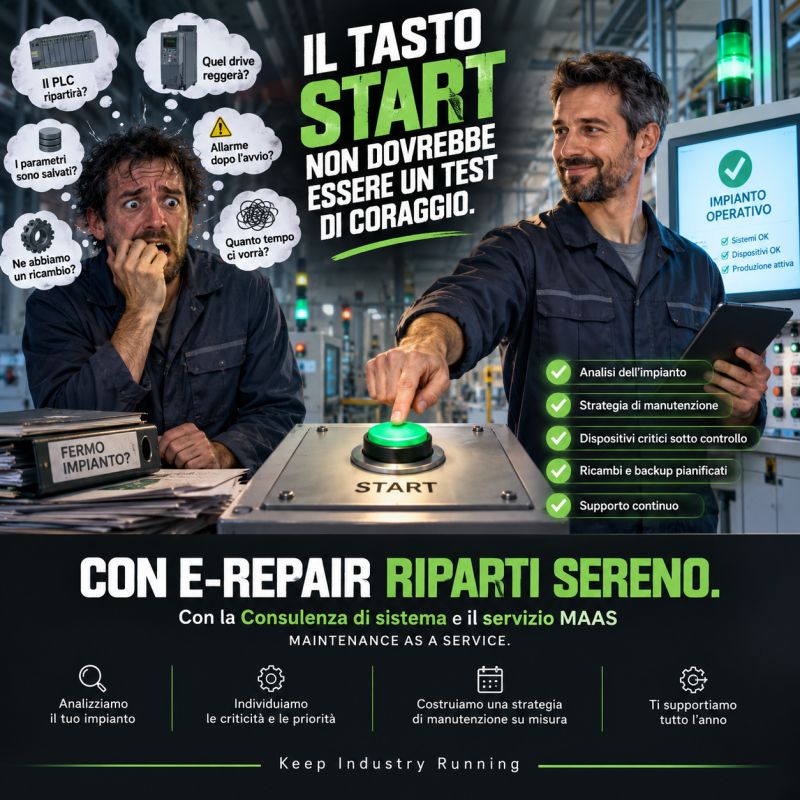
Pressing START after the holidays shouldn’t be a test of courage
Restarting after a production break takes more than a finger on the button. Knowing the plant’s critical points and planning maintenance helps you approach the restart better prepared.
The plants have been idle for a few weeks. Orders are waiting, deliveries are scheduled and production has to restart.
The maintenance manager approaches the line. He puts his finger on the START button and, for a moment, several questions run through his mind.
Will the PLC restart? Will that drive that had already reported an anomaly work properly? Were the parameters saved? Is the spare part for that obsolete component available?
Then he presses the button.
A few seconds of silence. Which, at that moment, feel much longer than expected.
Restarting shouldn’t depend on hoping everything goes well. It should be a prepared activity, with clear priorities and defined actions to deal with any problems.
Critical issues don’t go on holiday
A production break offers the opportunity to schedule checks and interventions. But simply stopping the plant does not solve the anomalies present before the shutdown.
A device that had shown irregular behaviour deserves a check. An obsolete component still needs a management strategy. A missing backup remains a critical issue even if, until then, it has never been needed.
The restart can bring unresolved problems to light. That is why it is useful to collect and analyse reports before the stop, so they are not forgotten between the last production day and the return.
The plant’s memory must remain available even when people change shifts or activities are interrupted.
Before START, the right questions
Preparing the restart means knowing which elements could hinder it and how to deal with them.
Useful questions include:
-
Which electronic devices are critical to the operation of the line?
-
Which anomalies were detected before the shutdown?
-
Are programs, parameters and backups available and correctly identified?
-
Are strategic spare parts compatible and have they been tested?
-
Which obsolete components are hard to source?
-
Who steps in if there is a problem, and with what information?
These answers help distinguish urgent activities from those that can be scheduled, and better organise resources, spare parts and technical support.
System Consulting: knowing the plant to make decisions
E‑Repair System Consulting starts from an analysis of the plant and its electronic devices, with the aim of identifying critical issues and intervention priorities.
The point is to understand the role of the equipment in the production process: how important it is to the line, what problems it has shown and what the consequences of its unavailability would be.
This analysis makes it possible to build, together with the customer, a maintenance and production continuity strategy, basing decisions on the plant’s real needs.
Knowing about a critical issue before the restart gives you time to assess it and prepare a response.
👉 Discover E‑Repair System Consulting
MAAS: from analysis to operating plan
Once priorities have been identified, they need to be turned into concrete activities.
With MAAS – Maintenance as a Service, E‑Repair structures an operating plan tailored to the plant and production needs.
The model can include preventive, predictive, reactive and improvement maintenance, together with scheduled services, backups and support for critical devices. Activities are agreed according to the condition of the equipment, the available data and the customer’s objectives.
The value of the plan lies in continuity of management: checks, interventions and information become part of an organised path, with defined priorities and responsibilities.
👉 Discover MAAS – Maintenance as a Service
Fast intervention is prepared in advance
During downtime, even gathering information can take time: identifying the device, retrieving the configuration, checking a spare part or reconstructing the history of the anomaly.
Having these elements already available can make diagnosis more orderly and help organise the intervention.
Planning does not eliminate every surprise. But it makes it possible to face it better prepared, reducing the decisions to be made when production is already waiting.
The question “What happens if this component doesn’t restart?” deserves an answer before your finger is on the START button.
Restarting with greater operational confidence
The return after the holidays is an important moment for production. Facing it with up-to-date information, tested spare parts and a maintenance plan helps manage any difficulties better.
With System Consulting and the MAAS model, E‑Repair supports companies in understanding and caring for their industrial electronics, linking interventions to the needs of the plant.
Restarting quickly is important. Restarting prepared, without relying on the courage of whoever presses START, is definitely better.
Contact E‑Repair to assess System Consulting and a MAAS plan suited to your production.
Keep Industry Running.