ES
 DE
 FR
 IT



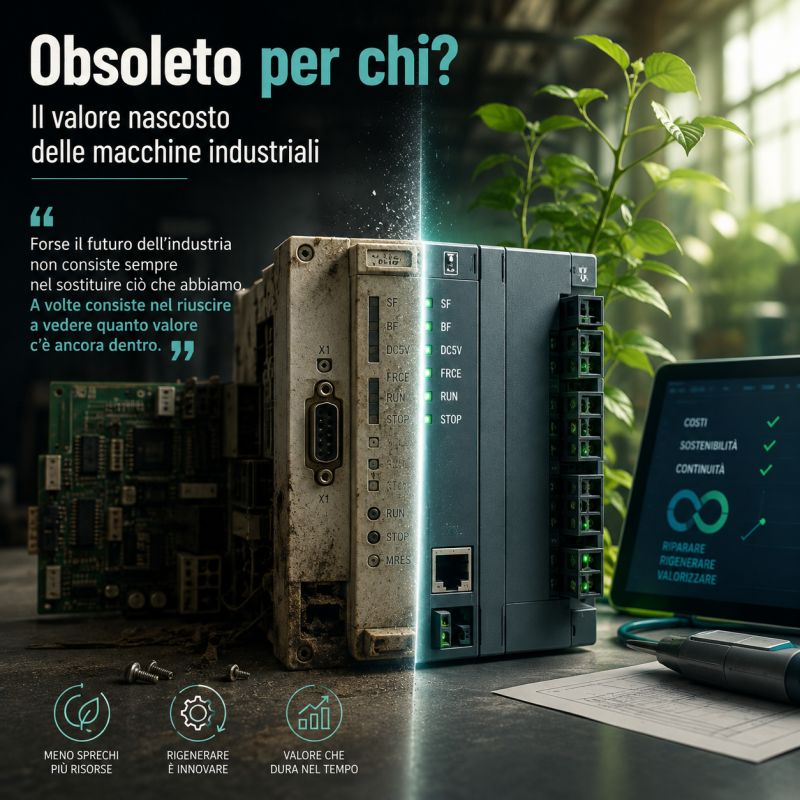
Obsolete for whom? The hidden value of industrial machines
When does an industrial machine really become obsolete?
When the manufacturer stops making it? When a component is dropped from the catalogue? When original spare parts become hard to find? Or when a newer technology arrives on the market?
The answer seems simple, but it isn’t.
In an industrial system increasingly focused on innovation, we tend to automatically associate “new” with “better”. Yet factories all over the world are still running machines and plants installed many years ago, thoroughly known by technicians and maintenance staff and still able to deliver reliability, quality and productivity.
Perhaps, then, we should distinguish more carefully between commercial, technological and functional obsolescence.
When an obsolete component does not make a machine obsolete
A component can go out of production while the machine it is installed in still retains much of its productive value.
PLCs, inverters, drives, power supplies, operator panels, electronic boards and other automation devices can become hard to source long before the plant they work in has actually reached the end of its service life.
This is where a paradox arises.
A relatively small component can call into question the future of a far larger industrial investment.
When a failure occurs, the first question should therefore not necessarily be “What can we replace it with?”, but also:
“Can we recover, repair or remanufacture it while maintaining reliability, safety and production continuity?”
The cost of replacement is not just the purchase price
When considering replacing a machine or a technology, simply comparing the cost of the new one with the cost of repair risks giving an incomplete picture.
The real cost of replacement can include many other elements: design, installation, plant modifications, software, integration, testing, production downtime, staff training and process adaptation.
On top of these come aspects that are less immediately quantifiable.
A machine used for many years in fact embodies a wealth of knowledge: operators know how it behaves, maintenance staff know its weak points, the company has established procedures and the whole production process has often been optimised around that technology.
In some cases, replacing it also means replacing part of this experience.
That is why a proper assessment should consider the Total Cost of Ownership (TCO) and not just the initial price of the new technology.
Repairing and remanufacturing also means protecting industrial capital
Extending the service life of a component does not simply mean postponing a purchase.
When technically and economically sustainable, remanufacturing can become a tool to protect the investments the company has already made.
An industrial component contains raw materials, energy, design, processing, transport and economic value already built in.
Throwing it away when it can still be recovered means losing part of that value.
Repairing or remanufacturing it means trying to keep that value within the production system instead.
It is one of the fundamental principles of the circular economy: keeping products, components and materials at their highest possible value for as long as possible.
Environmental and economic sustainability can go in the same direction
Every new component has to be manufactured.
It takes raw materials, energy, industrial processing, packaging and transport. And when a component is replaced, the old one also has to be disposed of.
Extending the service life of equipment can therefore help reduce the consumption of new resources and the production of waste.
But there is also a second, equally important form of sustainability: the economic one.
For a manufacturing company, preserving a reliable plant, reducing unnecessary investments and limiting downtime can free up resources for other areas that truly need innovation.
From this perspective, circularity stops being only an environmental choice and also becomes industrial strategy.
But remanufacturing does not mean keeping everything
The circular economy does not mean opposing innovation.
Some machines must be replaced because they are no longer safe, efficient, competitive or suited to production needs. Some new technologies offer energy, digital and production advantages that make a new investment the rational choice.
The point is therefore not to choose ideologically between old and new: the real challenge is to understand where to innovate and where, instead, to make the most of what already exists.
🔄 Replace when necessary.
🔧 Repair when possible.
♻️ Remanufacture when it can restore reliability and value.
💡 Innovate where innovation brings a real benefit.
From obsolescence to strategic life cycle management
For industrial companies, the issue becomes even more relevant when obsolescence is addressed before the failure occurs.
Knowing which installed components are entering the obsolescence phase, identifying those that are critical for production, checking whether they can be repaired and planning any interventions makes it possible to turn a future problem into a planned decision.
Obsolescence management thus becomes part of the maintenance and production continuity strategy; it is not simply about keeping an old machine running longer.
It is about consciously deciding how much industrial value it can still generate.
The hidden value in what we already have
Perhaps we are too used to measuring innovation by what we buy new.
But part of industrial innovation can also come from the ability to better understand, maintain, repair and remanufacture what we already have.
It is a perspective that brings together technology, technical expertise, the circular economy and competitiveness.
Because a component declared obsolete does not necessarily make everything around it obsolete.
And because the end of life of a machine should not be determined only by what is in a catalogue, but by its ability to keep producing reliably, safely, efficiently and in an economically sustainable way.
Perhaps the future of industry does not always lie in replacing what we have. Sometimes it lies in being able to see how much value is still inside.