ES
 DE
 FR
 IT



Siemens confirmed as world leader in industrial automation
🚀 Siemens confirms its position as one of the world’s leading players in industrial automation, thanks to an integrated technology ecosystem that includes controllers, engineering software, HMI systems, drives, Motion Control, Industrial Edge, artificial intelligence and Digital Twin.
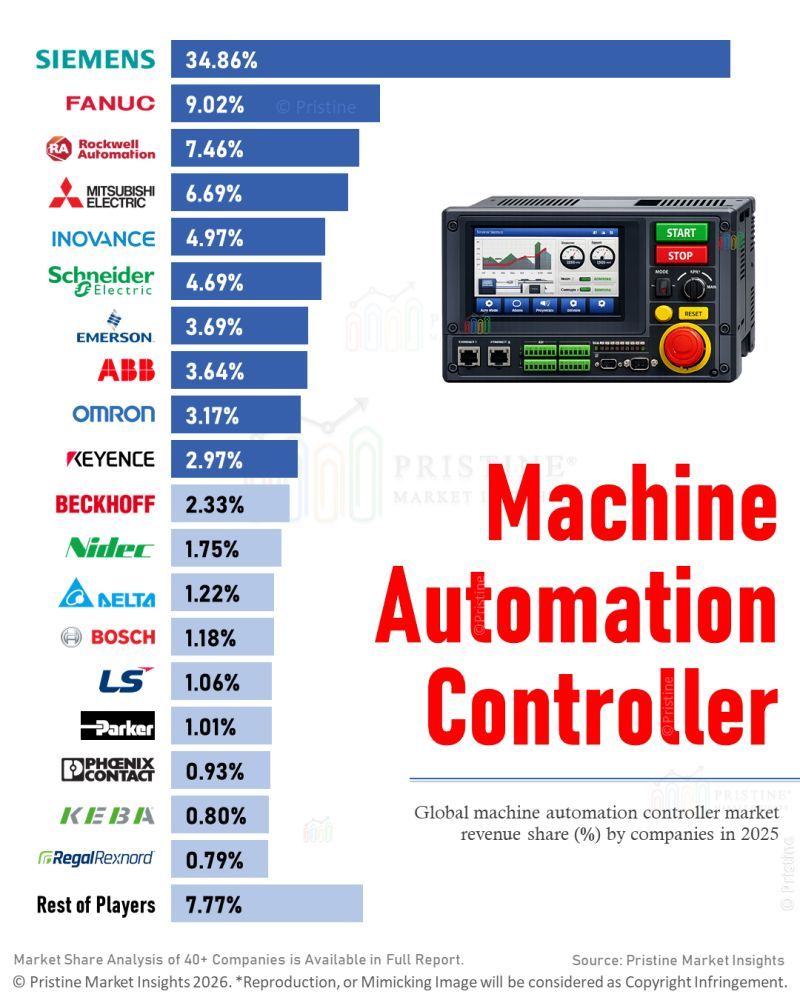
According to a 2025 market survey attributed to Pristine Market Insights, Siemens holds a 34.86% share of the global Machine Automation Controller market, well ahead of the other major manufacturers.
The figure refers to the specific segment of machine automation controllers, not to the entire industrial automation market. Nonetheless, it confirms Siemens’ central role in developing the technologies used to control, monitor and digitalise machines and production plants.
🏭 What are Machine Automation Controllers?
Machine Automation Controllers are the heart of modern automation systems.
These devices receive and process information from sensors, actuators, motors and supervisory systems, coordinating the operation of machines and production lines in real time.
This category includes different technological solutions:
🔹 industrial PLCs
🔹 modular and compact controllers
🔹 PC-based systems
🔹 dedicated Motion Control controllers
🔹 integrated platforms for automation, safety and axis management
The growing complexity of plants requires increasingly powerful, connected controllers able to integrate automation, data collection, diagnostics and cybersecurity.
💡 Why Siemens holds a leading position
Siemens’ position does not depend solely on the performance of a single product.
Its main strength is the ability to use a broad, integrated technology ecosystem, able to support companies throughout the entire automation and digitalisation process.
Siemens states that it ranks first in industrial software and automation and that around 33% of the machines installed worldwide use a Siemens controller.
The ecosystem includes, among others, the following technologies:
🔹 SIMATIC S7-1200 and S7-1500 PLCs
The SIMATIC S7-1200 and S7-1500 families make it possible to build scalable automation solutions, from the most compact applications to complex plants requiring high performance, integrated safety functions and advanced motion management.
SIMATIC controllers are one of the most widespread standards in industrial automation and can be integrated with HMI systems, drives, distributed I/O and industrial networks.
----
🔹 TIA Portal
The Totally Integrated Automation Portal, known as TIA Portal, makes it possible to configure, program and manage different plant components within a single engineering environment.
Being able to work on PLCs, HMIs, networks, drives and safety systems through a common platform makes it possible to:
🔸 reduce engineering time;
🔸 standardise applications;
🔸 simplify diagnostics;
🔸 make maintenance activities more efficient;
🔸 store and update software projects in a structured way.
STEP 7, integrated into TIA Portal, is the Siemens software used to configure, program and maintain automation systems and SIMATIC PLCs.
----
🔹 HMI systems and WinCC Unified
SIMATIC HMI systems and the WinCC Unified platform allow operators to visualise and control machines, lines and production plants.
WinCC Unified can be used on operator panels, industrial PCs and Edge environments, providing data acquisition, alarm management, supervision and analysis of information from the production process.
----
🔹 Drives and Motion Control
The Siemens portfolio also includes SINAMICS drives, SIMOTICS motors and SIMATIC Motion Control solutions.
The integration of controller, drive, motor, HMI and engineering system makes it possible to develop coordinated applications for:
🔸 positioning;
🔸 axis synchronisation;
🔸 automated handling;
🔸 machine tools;
🔸 packaging lines;
🔸 high-dynamic systems.
SIMATIC Motion Control solutions are integrated into TIA Portal and can be combined with SINAMICS drives, SIMOTICS motors, HMI systems and automation I/O.
----
🔹 Industrial Edge
Industrial Edge makes it possible to process data right next to machines and plants, reducing response times and making it easier to integrate production systems with IT applications.
Through Edge computing, production data can be used to:
🔸 monitor equipment performance;
🔸 detect anomalies;
🔸 develop predictive maintenance applications;
🔸 improve traceability;
🔸 optimise consumption and processes.
----
🔹 Artificial intelligence and Digital Twin
The integration of automation, operational data, simulation and artificial intelligence opens up new possibilities for plant design and management.
The Digital Twin makes it possible to create a digital representation of a product, a machine, a process or an entire plant.
Using virtual models and real data, it is possible to simulate scenarios, test changes and optimise performance before physically intervening in production. Integration with artificial intelligence can also support data analysis and predictive maintenance.
⚙️ Technology leadership does not depend on innovation alone
Having powerful controllers, advanced software and integrated systems is an important competitive advantage.
However, the real reliability of an industrial ecosystem does not depend only on introducing new products.
To ensure production continuity, the entire life cycle of the installed electronics must be managed, also taking into account:
🔹 preventive maintenance;
🔹 fault diagnostics;
🔹 spare parts availability;
🔹 backup storage;
🔹 repair of faulty components;
🔹 remanufacturing of industrial electronics;
🔹 obsolescence management;
🔹 planning the migration to new technologies.
Many plants use devices from different generations at the same time. Alongside the latest SIMATIC S7-1200 and S7-1500, there may still be S7-300 and S7-400 PLCs, operator panels, CNCs, industrial PCs and drives installed many years ago.
In these cases, replacing the entire plant is not always the most technically or economically viable solution.
♻️ Repair and remanufacturing to extend plant life
Being able to repair and remanufacture industrial electronic components allows companies to:
🔹 extend the service life of plants;
🔹 reduce the risk of production downtime;
🔹 contain replacement costs;
🔹 keep strategic machines running;
🔹 phase investments more gradually;
🔹 reduce the consumption of raw materials and the production of electronic waste.
Remanufacturing should not be seen only as a response to failure.
It can become part of a planned maintenance strategy, especially for critical, obsolete or hard-to-source equipment.
💡 Innovation and managing existing assets are not opposing strategies.
New technologies make plants more connected, flexible and intelligent. Maintenance, repair and remanufacturing, on the other hand, protect the investments already made and support technological evolution without compromising production continuity.
🔧 E-Repair’s support for Siemens industrial electronics
As a Siemens Approved Partner – Industry Services, E-Repair supports companies in managing the Siemens industrial electronics installed on machines and production plants.
Activities include:
🔹 component-level industrial electronics repair;
🔹 electronic remanufacturing with a zero-hour reset of wear-prone components;
🔹 preventive maintenance and professional equipment cleaning;
🔹 backups of PLCs, CNCs, HMIs and drives;
🔹 advance supply of remanufactured components;
🔹 technical interventions and remote support;
🔹 assessment of the condition of installed electronics;
🔹 definition of obsolescence management strategies.
The aim is to help companies keep their plants running, reducing the risk of sudden failures and building a maintenance strategy consistent with the characteristics of their production.
🌐 Preparing for the challenges of Industry 4.0 and 5.0
Investing in Siemens technologies means adopting an ecosystem that can integrate automation, supervision, data, simulation and artificial intelligence.
But it also means developing the skills needed to manage these technologies throughout their life cycle.
Industrial competitiveness will increasingly depend on the ability to combine:
🔹 digital innovation;
🔹 operational continuity;
🔹 technical skills;
🔹 safety and reliability;
🔹 planned maintenance;
🔹 sustainability and the circular economy.
🚀 Leadership in automation is not measured only by the ability to build innovative technologies, but also by the ability to keep them efficient, available and operational over time.
E-Repair supports companies in protecting and making the most of their Siemens industrial electronics, helping to build more reliable, resilient and sustainable plants.