ES
 DE
 FR
 IT









The pharmaceutical industry and the Strait of Hormuz: why maintenance protects production continuity
When people talk about the Strait of Hormuz, attention almost always focuses on oil, gas and the consequences that its possible closure or restriction could have on international energy markets.
This is understandable: Hormuz is one of the world’s main transit points for oil and liquefied natural gas.
But the effects of a prolonged crisis would not be limited to the cost of energy.
Among the most exposed sectors, although it is still discussed far too little, is in fact the pharmaceutical industry.
Medicine production does not depend on oil only for the energy needed to power plants.
The relationship is far more complex: many pharmaceutical processes use products and services linked directly or indirectly to the energy and petrochemical supply chains:
◆ active ingredients and chemical intermediates;
◆ industrial solvents and reagents;
◆ plastic materials used in packaging;
◆ resins, protective films and packaging components;
◆ sea, air and land transport;
◆ refrigerated systems and cold chains;
◆ continuous and stable electricity;
◆ electronic components and spare parts for production plants.
The chemical industry, on which many supplies used in the pharmaceutical sector depend, is one of the most energy-intensive industrial sectors.
Oil and gas are not only energy sources: they are also raw materials for the production of many petrochemical products.
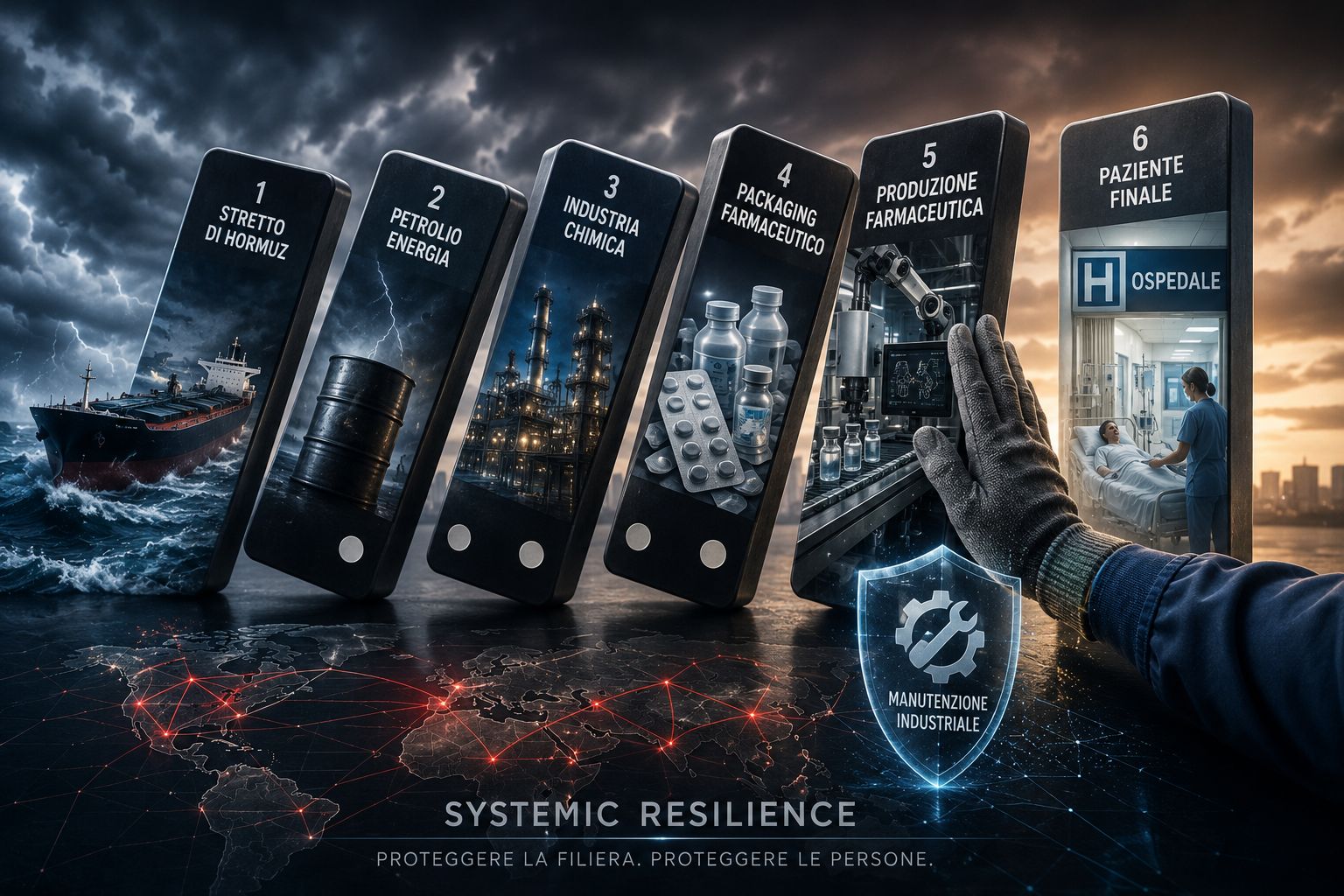
A crisis in the Strait of Hormuz can therefore spread along the supply chain through several channels:
📈 higher energy and raw material prices;
🚢 slower shipping routes;
⏳ longer procurement lead times;
📦 unavailability of packaging materials;
⚠️ greater difficulty sourcing components and spare parts;
💶 rising logistics and production costs.
The passage does not need to be completely blocked.
Even reduced flows, higher insurance risks, route changes or slower port operations can have significant consequences.
A supply chain already exposed to many weaknesses
The vulnerability of pharmaceutical supply chains did not begin with tensions in the Strait of Hormuz.
The pandemic, international logistics crises, geopolitical conflicts and the geographical concentration of certain production have already shown how difficult it can be to ensure the continuous availability of medicines.
Shortages can result, among other causes, from:
◆ production problems;
◆ supply interruptions;
◆ supply chain vulnerabilities;
◆ health emergencies;
◆ international competition for resources and materials.
Shortages are not only an industrial or commercial problem: they can increase pressure on healthcare systems and put continuity of care at risk.
That is precisely why the European Union has launched specific initiatives to strengthen security of supply, diversify sourcing and reduce dependence on individual countries or suppliers.
What can happen inside pharmaceutical plants
When a geopolitical crisis limits the availability of resources, companies tend to focus on external supplies: energy, raw materials, logistics and transport.
But there is another equally important variable: the reliability of production plants.
Once the necessary raw materials are available, the plant must be able to process, package and distribute them without unexpected interruptions.
A pharmaceutical line relies on complex, closely interconnected systems:
⚙️ PLCs and industrial controllers;
🖥️ HMI operator panels;
🔌 inverters and drives;
🤖 automation systems;
🌡️ sensors and control devices;
❄️ refrigeration systems;
📦 automatic packaging lines;
🗄️ supervision, traceability and data acquisition systems.
The failure of just one of these components can slow down or stop the entire line.
Under normal conditions, plant downtime is an economic and organisational problem; during a supply chain crisis, however, it can have even more serious consequences.
When raw materials, energy and logistics capacity are limited, losing hours or days of production because of an avoidable failure means wasting resources that are hard to replace.
Stopping a pharmaceutical line is not just a loss of production:
A line stoppage can lead to:
◆ failure to produce essential medicines or devices;
◆ delays in packaging processes;
◆ loss of materials or intermediate products;
◆ the need to repeat checks and validation procedures;
◆ difficulty meeting delivery schedules;
◆ pressure on available stocks;
◆ slower distribution to pharmacies, hospitals and healthcare facilities.
The availability of medicines therefore depends on a chain in which every step is essential: procurement, production, quality control, packaging, storage and distribution.
💡 In this system, plant maintenance is not an ancillary function, but a component of production security and, indirectly, of healthcare security.
From corrective maintenance to industrial resilience
For many years, maintenance was seen mainly as a corrective activity: a component fails, the line stops and the technical department steps in to restore it.
This approach is increasingly incompatible with automated plants, regulated production and unstable supply chains.
Industrial resilience requires a more structured strategy, based on the ability to:
🔹 prevent failures;
🔹 identify the most vulnerable components in advance;
🔹 have critical spare parts available;
🔹 reduce recovery times;
🔹 protect programs and configurations;
🔹 keep even mature or obsolete equipment running;
🔹 find alternative solutions when original spare parts are not immediately available.
💡 The question to ask is therefore not only: “How much does it cost to maintain this component?”
The right question becomes: “How much do we risk losing if this component fails and we cannot replace it quickly?”
Mapping critical equipment
The first step in strengthening production continuity is knowing the installed base.
Many companies still lack a complete, up-to-date map of the PLCs, HMIs, inverters, drives, power supplies and electronic equipment in their plants.
E-Repair, Siemens approved Service Partner, carries out a technical survey that makes it possible to identify:
◆ component manufacturer and part number;
◆ the line and function it is associated with;
◆ criticality level;
◆ obsolescence status;
◆ market availability;
◆ average procurement lead times;
◆ in-house spare parts;
◆ backup availability;
◆ repair or remanufacturing options;
◆ any technical alternatives.
This information makes it possible to set priorities and investments based on real risk.
A component of limited economic value can in fact become extremely critical when it is out of production, has no duplicate in stock and controls an essential process step.
Spare parts, remanufacturing and obsolescence management
With unstable supply chains, relying solely on buying new components may not be enough.
Some equipment may have very long lead times, while other units may already be out of production.
Resilience therefore requires a combination of solutions, which E-Repair, Siemens Approved Partner, provides:
🔧 component-level repair, to recover faulty equipment without depending solely on the availability of new parts;
♻️ “zero-hour” remanufacturing, to restore devices to controlled working condition and extend their life cycle;
📦 strategic spare parts stocks, defined by criticality and not just by component value;
🔄 advance remanufactured replacement, to quickly replace the faulty device and reduce downtime;
🧠 preventive and predictive maintenance, to detect signs of deterioration before a stoppage;
🛠️ retrofit and obsolescence management, when maintaining existing technology is no longer technically or economically sustainable.
It is not about stockpiling spare parts indiscriminately, but about building a strategy consistent with production risk.
Automation backup and disaster recovery
Another often underestimated element is technical data.
Physically replacing a PLC, an operator panel or a control system may not be enough when the following are not available:
◆ up-to-date programs;
◆ hardware configurations;
◆ drive parameters;
◆ production recipes;
◆ compatible software versions;
◆ licences;
◆ passwords and technical credentials;
◆ documentation of changes made over time.
Losing a configuration can prolong downtime far more than the hardware failure itself.
That is why a production continuity strategy should include verified backups, recovery procedures and protected copies of critical configurations.
💡 A backup should not be considered truly available until it has been checked and its restorability verified.
Industrial maintenance and security of supply
The security of pharmaceutical supply chains is often addressed through supplier diversification, European production and stockpiling: these measures are essential, but not sufficient.
Having active ingredients, packaging materials and energy available does not guarantee production continuity if the line is stopped by a failed obsolete PLC, an unobtainable inverter or an operator panel without a backup.
Pharmaceutical resilience must therefore cover at least three dimensions:
1. Supply resilience
Supplier diversification, raw material availability, stock management and control of geographical dependencies.
2. Energy and logistics resilience
Energy continuity, alternative transport, storage capacity and protection of the cold chain.
3. Plant resilience
Reliable automation, preventive maintenance, spare parts availability, backups and rapid recovery capability.
The absence of just one of these components can compromise the entire system.
Preparing before the crisis reaches the plant
Geopolitical crises cannot be controlled by individual companies.
But companies can decide how vulnerable they are to the consequences, and preparing means analysing in advance:
🔎 which equipment could stop production;
📊 what economic and operational consequences each stoppage would have;
📦 which spare parts must be immediately available;
⏱️ what the realistic repair or replacement times are;
💾 whether programs, parameters and configurations are protected;
♻️ which components can be repaired or remanufactured;
🛠️ which technologies need a retrofit plan;
🤝 which technical partners can step in quickly in an emergency.
This analysis makes it possible to move from reactive maintenance to a true industrial business continuity strategy.
E-Repair’s role in pharmaceutical production continuity
E-Repair supports companies in managing and maintaining electronic equipment and industrial automation, with services designed to reduce the risk and duration of plant downtime.
Activities may include:
◆ survey and analysis of the installed base;
◆ assessment of criticality and obsolescence;
◆ component-level electronic repair;
◆ “zero-hour” remanufacturing;
◆ advance remanufactured replacement;
◆ management of strategic spare parts stocks;
◆ backup of programs and configurations;
◆ preventive, improvement and predictive maintenance;
◆ on-site and remote technical support;
◆ support for retrofit and disaster recovery projects.
Work is carried out by specialist technicians and, where applicable, in our certified in-house laboratory, with functional tests and documented procedures.
The aim is not simply to repair a device, but to help make plants more reliable, reduce recovery times and protect the continuity of production processes.
Maintenance becomes a strategic choice
The Strait of Hormuz shows how a geographically distant event can have concrete consequences inside a European plant.
Energy, chemicals, plastics, transport and spare parts availability all belong to closely interconnected global supply chains.
In the pharmaceutical sector, however, production continuity takes on even greater importance: stopping a line does not only mean losing revenue or efficiency; in some cases it can mean slowing down the production, packaging and distribution of products essential to people’s health.
That is why industrial maintenance can no longer be considered merely a technical cost.
🌍It is a strategic component of industrial resilience, security of supply and continuity of healthcare. 💊