ES
ES  DE
DE  FR
FR  IT
IT 








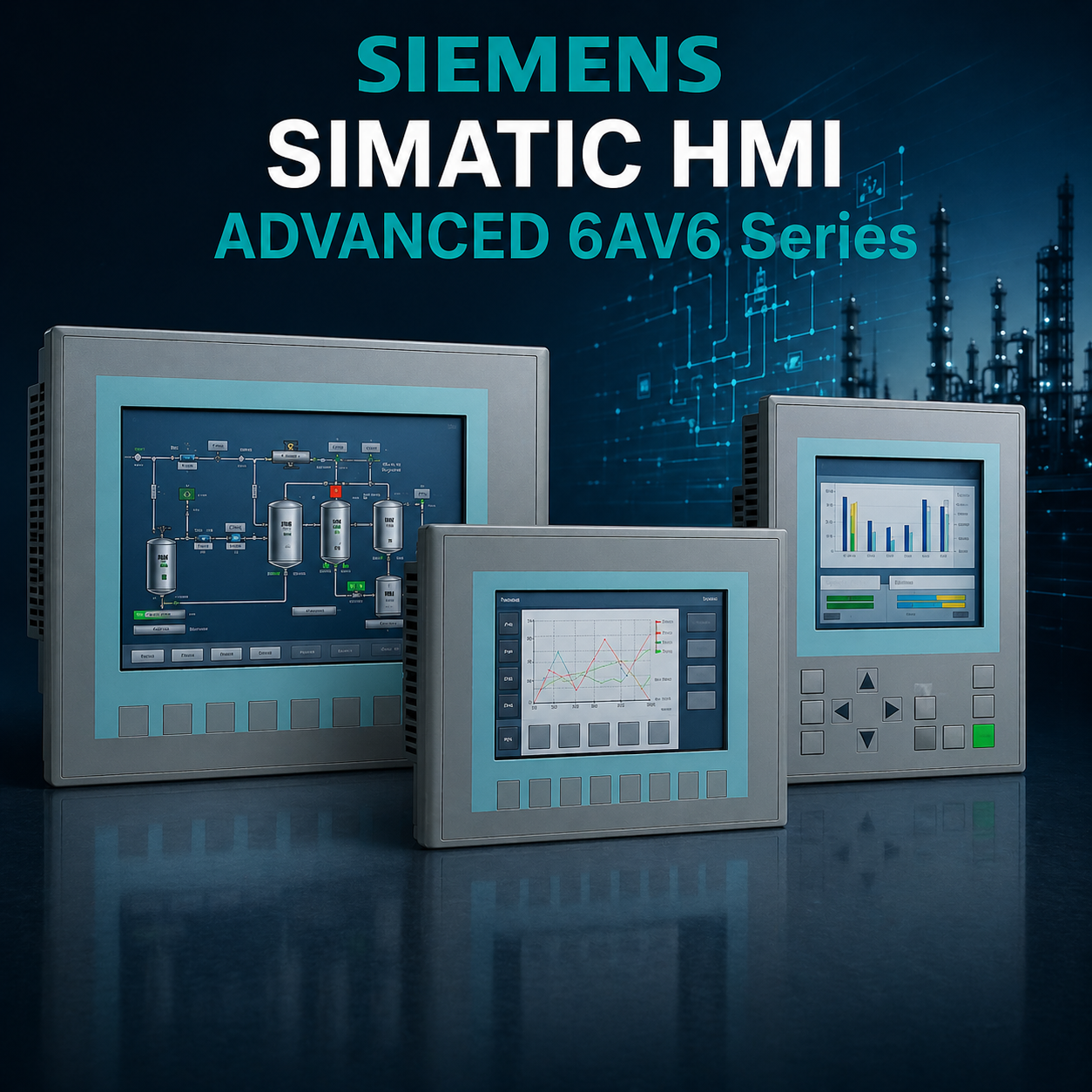
Siemens SIMATIC HMI Advanced – 6AV6 series
In the catalog of Siemens, the 6AV6… family identifies a range of Advanced HMI systems, designed for complex industrial applications and integration with SIMATIC S7 systems.
These devices represent a key evolutionary stage in the history of Siemens HMIs, positioned between:
- Legacy HMI (SIMATIC S5 and early S7 – 6AV3 / 6AV4)
- Modern HMI (Basic, Comfort, Unified – 6AV2)
👉 The 6AV6 series therefore represents the advanced intermediate level of the human-machine interface.
🧠 What are Siemens Advanced HMIs
Advanced HMIs are high-performance operator panels used for:
🖥️ advanced supervision of industrial processes
⚙️ full machine control
🔧 parameter management and diagnostics
🚨 complex alarm handling
👉 They are designed for systems requiring higher operational capabilities than basic HMIs.
⚙️ Main technical features – 6AV6 series
Devices belonging to the 6AV6 family are characterized by:
- advanced graphical interfaces
- color displays with higher resolution
- integration with SIMATIC S7 PLCs
- PROFIBUS and Industrial Ethernet communication
- compatibility with SCADA systems (WinCC)
👉 For many years, they have been the standard for advanced industrial applications.
⚠️ Production continuity: the role of Advanced HMIs
Advanced HMIs are often still installed in operating plants.
A failure may cause:
❌ loss of advanced machine control
❌ diagnostic difficulties
❌ downtime in complex systems
❌ loss of operational data
👉 These are critical devices for production continuity.
🛠️ E-Repair services for Siemens Advanced HMIs
E-Repair offers a complete range of services focused on production continuity:
🔧 Component-level repair in an in-house laboratory
♻️ Electronic remanufacturing with zero-hour reset
⚡ Advance replacement service with remanufactured units
🧠 HMI data backup and recovery
🧰 On-site and remote technical support
🧼 Technological cleaning with biodegradable solvents
👉 Interventions compliant with:
- ISO 14001 – Environmental management system
- ISO 14064-1 – Organizational Carbon Footprint
- BS 8001:2017 and AFNOR XP X30-901:2018 – Circular economy standards
🏭 Typical applications of Advanced HMIs
These devices are used in:
- robotic lines 🤖
- automotive plants 🚗
- CNC systems
- chemical plants 🧪
- complex automated machinery
👉 Where advanced supervision and control are required.
🔍 MLFB roots of Advanced HMIs – 6AV6 series
Within the 6AV6 family, Siemens identifies several sub-roots related to Advanced HMIs and legacy Mobile Panels.
This classification is essential to:
- correctly identify devices
- structure the technical catalog
- create SEO-oriented pages
- connect different HMI generations
🔹 6AV664x – Multi Panels and Advanced HMIs
Includes advanced operator panels used with SIMATIC S7 systems:
- MP277
- MP377
- advanced graphical panels
Characteristics:
- advanced HMI interfaces
- use in complex systems
- advanced process management
▪ 6AV664x sub-roots
👉 6AV6640 – basic graphical HMIs
👉 6AV6641 – compact HMIs
👉 6AV6642 – Operator Panels and Touch Panels
👉 6AV6643 – Multi Panels (MP277 / MP377)
👉 6AV6644 – application-specific HMIs
👉 6AV6645 – extended-function HMIs
👉 6AV6646 – advanced integrated HMIs
👉 6AV6647 – high-performance HMIs and Panel PCs
🔹 6AV667x – Mobile Panels (previous generation)
Includes portable operator panels for machine control:
- Mobile Panel 170 / 270
- systems with integrated safety
Used in:
- robotics
- automated systems
- complex machinery
▪ 6AV667x sub-roots
👉 6AV6671 – base Mobile Panel with safety
👉 6AV6672 – compact Mobile Panels
👉 6AV6673 – advanced Mobile Panels
👉 6AV6674 – application-specific Mobile Panels
👉 6AV6675 – high-performance Mobile Panels
👉 6AV6676 – top-performance Mobile Panels
🧠 Positioning within the Siemens HMI range
- 6AV3 / 6AV4 → Legacy HMI
- 6AV6 → Advanced HMI
- 6AV2 → Modern HMI (Basic, Comfort, Unified)
- 6AV8 → SCADA (WinCC)
👉 Advanced HMIs act as a bridge between legacy and modern technologies.
📌 Conclusion
SIMATIC HMI Advanced – 6AV6 series represent a key component in existing industrial plants.
Ensuring their proper operation means:
- maintaining complex systems operational
- reducing downtime
- planning technological evolution
🟢 Type: CLUSTER PAGE