Español (España)
  Deutsch (Deutschland)
  Français
  Italiano







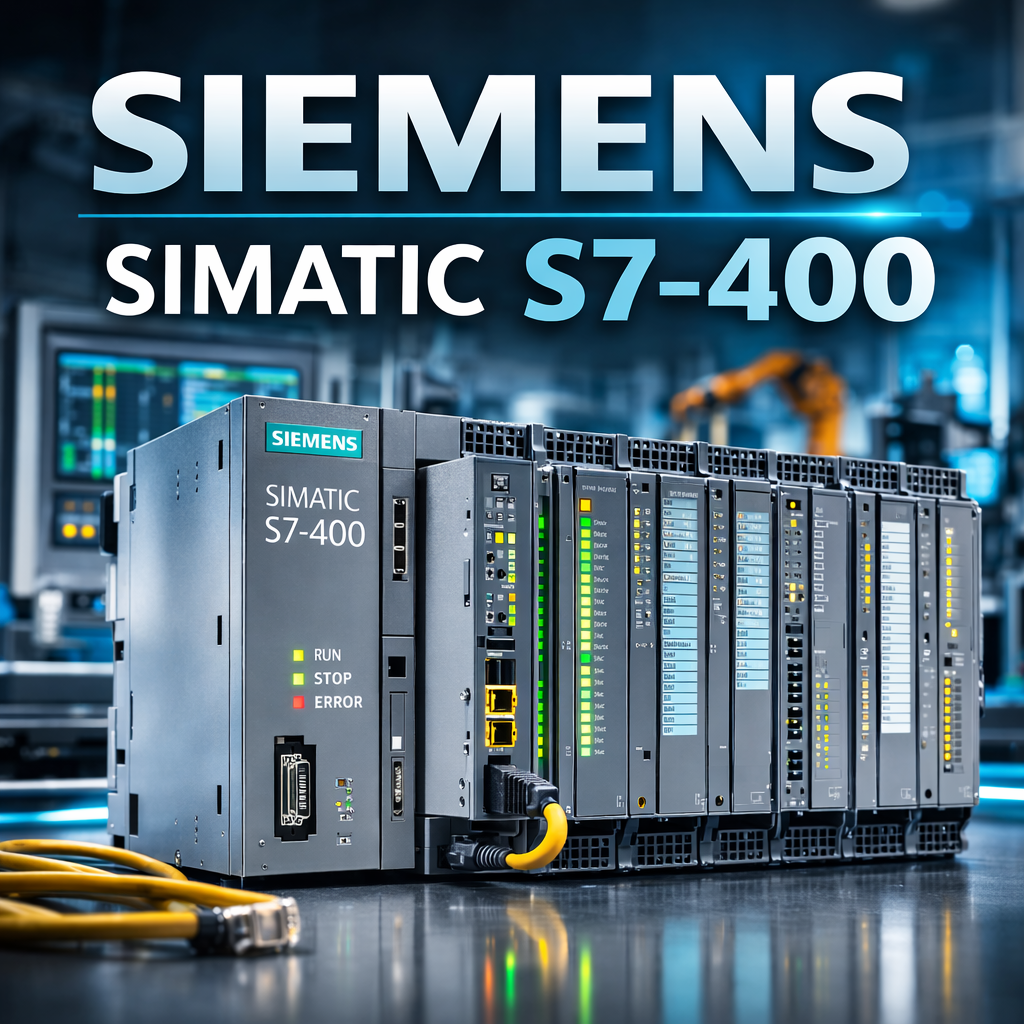
SIMATIC S7-400: the Siemens platform for complex automation and high-reliability processes
In the Siemens industrial automation landscape, SIMATIC S7-400 represents the modular PLC platform designed for large-scale applications, complex plants, and high-availability architectures.
Unlike compact or mid-range modular series, the S7-400 family is built for environments where the following are required:
⚙️ high processing capacity
🧩 extensive modularity
🔁 redundancy
🔗 process integration
📊 management of large volumes of I/O signals
What defines the SIMATIC S7-400 series
The series is primarily identified by the root:
- 👉 6ES7 4xx
This root includes:
⚙️ central CPUs
🔋 power supplies
🧱 racks
🔌 digital modules
📊 analog modules
🌐 communication modules
🔁 redundant interfaces
The Siemens design logic is clear:
🧠 S7-400 = centralized control for highly complex industrial plants
Main SIMATIC S7-400 product roots
Among the main roots we find:
👉 6ES7400 – racks and mounting frames
👉 6ES7405 – system power supplies
👉 6ES7412 – basic CPUs
👉 6ES7414 – standard CPUs
👉 6ES7416 – high-performance CPUs
👉 6ES7417 – advanced CPUs for complex processes
👉 6ES7421 – digital input modules
👉 6ES7422 – digital output modules
👉 6ES7431 – analog input modules
👉 6ES7432 – analog output modules
👉 6ES7441 – serial modules
👉 6ES7443 – Ethernet / PROFIBUS modules
👉 6ES7448 – special process modules
👉 6ES7460 – interface modules
👉 6ES7461 – IM units for rack expansion
Why S7-400 belongs to Siemens’ high-end segment
SIMATIC S7-400 is mainly used in:
🧪 chemical plants
⚡ power generation plants
🏭 rolling mills
🔩 steel plants
🔄 large continuous process lines
🛢️ petrochemical plants
🌐 critical infrastructure automation
Difference between S7-300 and S7-400
The main difference is:
🔹 S7-300 = standard modular automation
🔹 S7-400 = high-power, high-availability automation
Key differences include:
⚙️ CPU performance
💾 memory capacity
🧱 rack expandability
🔁 redundancy management
🛡️ fail-safe architectures
Most common issues in S7-400 systems
Over time, these systems may also experience:
⚠️ prolonged thermal stress
🔋 capacitor degradation
🧱 rack bus issues
⚡ power supply faults
🌐 communication module failures
🔌 industrial connector wear
E-Repair services for SIMATIC S7-400
For these industrial systems, E-Repair offers:
🔧 Repair in a Siemens-certified in-house laboratory
♻️ professional electronic remanufacturing
🧪 final functional testing
💾 backup and configuration management
🧼 technological cleaning
🚚 availability of remanufactured units when possible
🛡️ standard 12-month warranty
Why S7-400 deserves a dedicated cluster page
From an SEO and technical perspective, S7-400 captures strong search intent such as:
🔍 Siemens S7-400 CPU
🔍 S7-400 analog modules
🔍 Siemens legacy racks
🔍 Siemens PLC for large-scale plants
This family remains essential today, as many European plants still operate on S7-400 architectures.
The S7-400 roots still represent the core of many strategic industrial systems.
Understanding these roots means correctly interpreting a central part of the Siemens legacy catalog that is still fully operational.
🟢 Type: CLUSTER PAGE