Español (España)
  Deutsch (Deutschland)
  Français
  Italiano








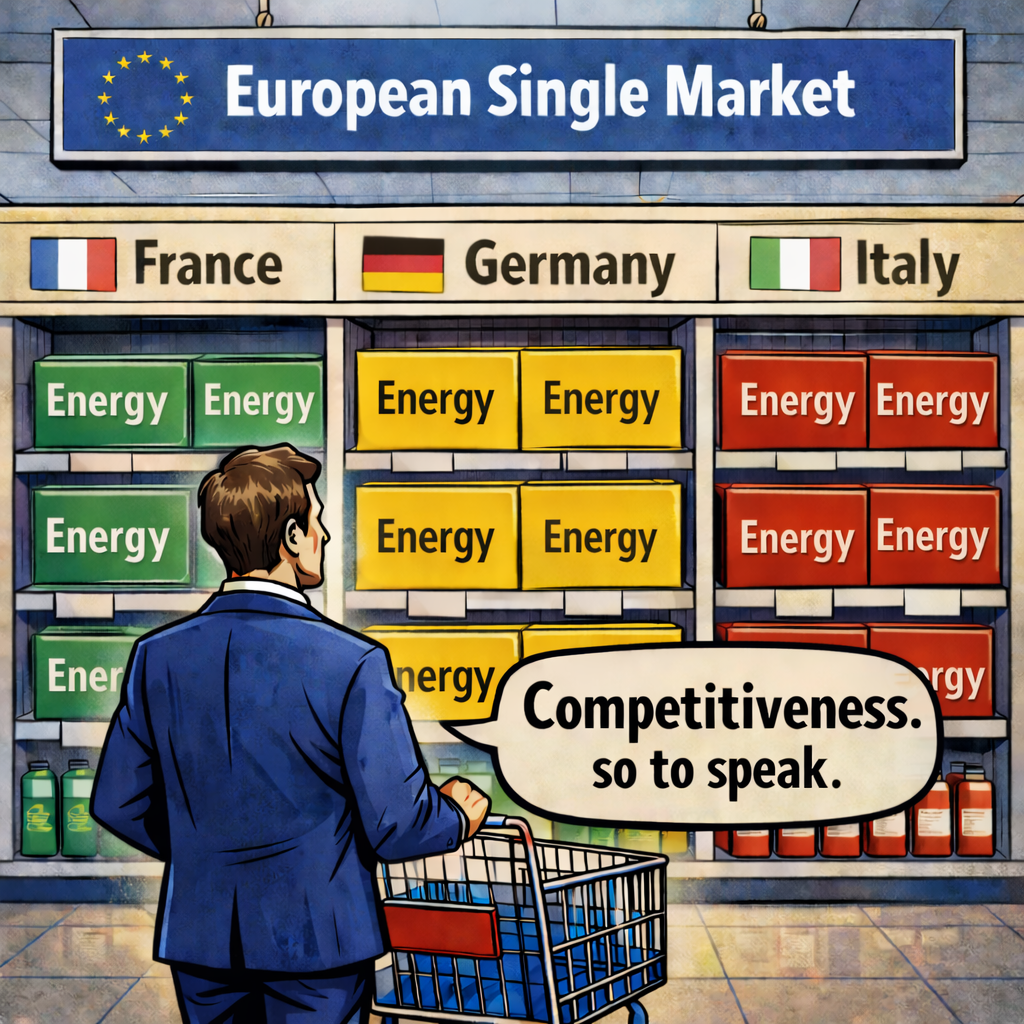
The Problem: Not All European Industries Start from the Same Point
Today, a European company does not compete only on product quality or innovation.
It also competes — and often above all — on energy costs.
If two companies produce the same component but:
-
one pays €80/MWh for energy
-
the other pays €160/MWh
it is no longer a technological competition.
It becomes a cost structure competition.
And this is precisely where the European issue arises:
the single market exists for goods and regulations… but not for energy.
Why Industrial Competitiveness Depends on Energy
In recent years, many European companies have started relocating production outside Europe.
Not because Europe has lost expertise.
But because industrial costs have become unpredictable.
A modern production plant requires:
-
operational continuity
-
multi-year planning
-
long depreciation cycles
-
energy stability
If energy costs change radically from country to country or from year to year, investment becomes a financial risk rather than an industrial one.
And when risk increases, capital moves.
Technological Neutrality: What It Really Means
One of the central points in the European debate is so-called technological neutrality.
In simple terms:
Europe no longer wants to impose a single energy solution for everyone.
Because industry is not uniform.
A steel plant, a data center, and a food production line do not have the same energy profile.
For this reason, the new policy direction aims at:
-
renewables where they work best
-
nuclear where it guarantees stability
-
hydrogen where it is efficient
-
gas where continuity is needed
This is not a return to the past.
It is an attempt to avoid a typical industrial policy mistake: applying one single rule to different systems.
One Market Act: The Real Objective
The European project aims to create a truly unified industrial market.
Not only free trade, but similar production conditions.
In practice:
a company should be able to decide where to invest in Europe without the choice depending solely on the energy bill.
To achieve this, three elements are needed:
-
more predictable energy
-
harmonized industrial rules
-
coordinated incentives among countries
Only in this way can Europe compete with continental-scale economies such as the United States and China.
What Changes for Companies
If the plan works, it will change the way production itself is managed.
Today, many companies operate in a defensive logic:
they intervene when something breaks.
Tomorrow, the logic becomes strategic:
production continuity becomes part of the competitive advantage.
When energy is stable and predictable:
-
investments return
-
production lines remain in Europe
-
maintenance becomes planning
-
downtime becomes a real economic risk
Not just a technical one.
The Real Issue: Where Production Will Take Place in the Future
Europe’s energy issue is not only about environmental sustainability.
It concerns the future industrial geography.
A continent that cannot produce steadily inevitably becomes dependent on those who can.
This is why the debate between Italy and Germany is not political:
it is industrial.
And the One Market Act is, first and foremost, a project of productive sovereignty.
Conclusion
In the coming years, the winner will not be the one with the most “perfect” energy, but the one with the most reliable energy.
Because in global industry, true innovation is not producing better once.
It is being able to produce consistently.
🟢 Content Page Article on production continuity linked to European energy policy, which can determine competitive advantages among industries in different Member States