Español (España)
  Deutsch (Deutschland)
  Français
  Italiano








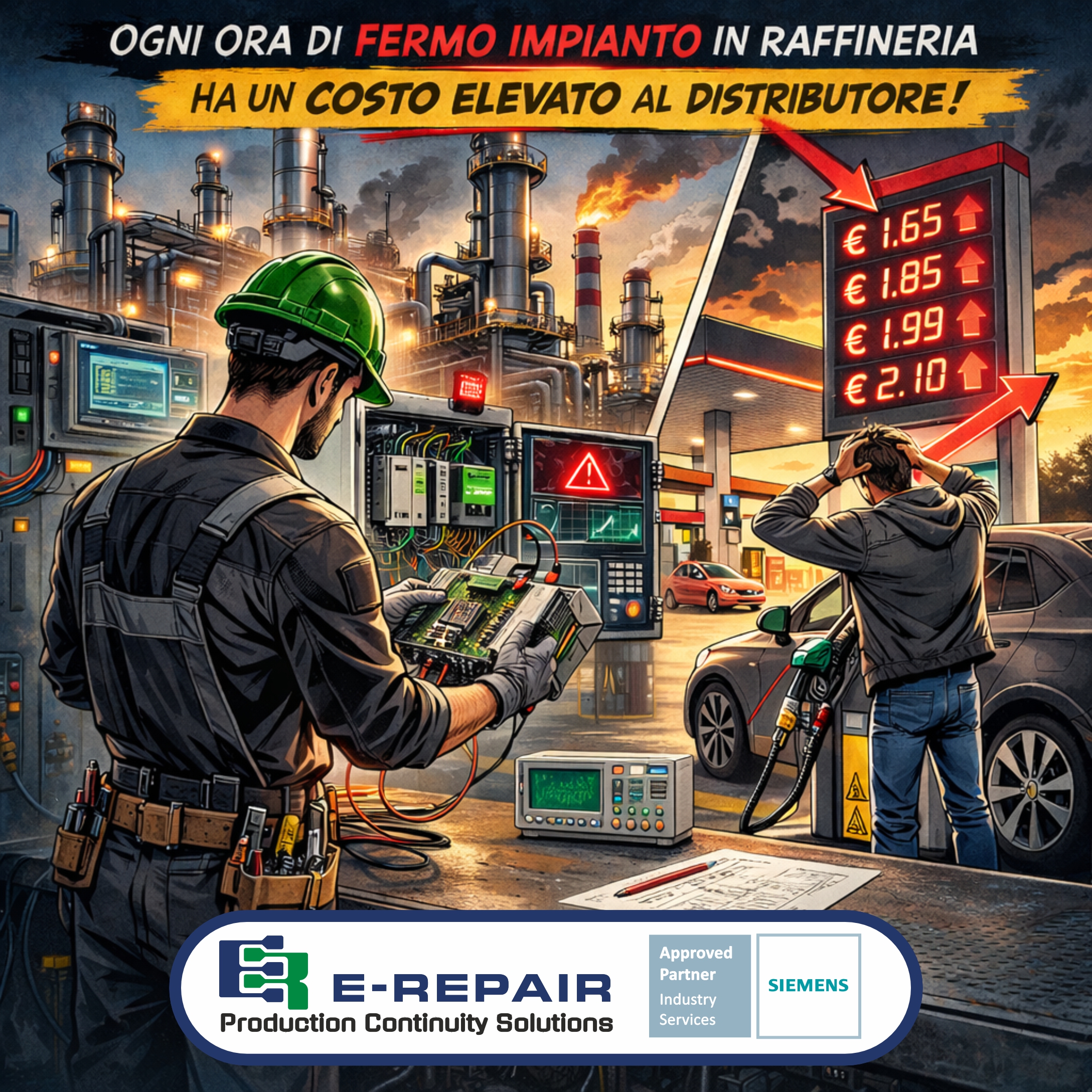
Refineries, production continuity and electronic maintenance: why every plant shutdown can affect the entire chain, all the way to the fuel station
Behind the final price of 🛢️ fuels and 🍃 biofuels lies an extremely complex industrial supply chain, in which every production phase requires stability, continuous control and system reliability.
In refinery plants, the transformation of energy raw materials takes place through highly complex technological processes, governed by industrial automation architectures that must operate continuously and safely.
Even a single electronic malfunction can generate significant consequences, not only within the plant itself, but across the entire energy supply chain.
⚙️ Critical electronic devices in refinery plants ⚙️
Inside refineries, numerous industrial electronic devices control fundamental processes:
⚙️ industrial PLCs for the automated management of pumps, valves and process lines
🖥️ HMI and operator panels for the continuous monitoring of production parameters
🔄 inverters and drives for electric motor control
🧠 process control systems for regulating critical variables
📡 electronic communication modules for dialogue between systems
🔋 industrial power supplies and continuity systems
These devices operate in harsh environments, often characterised by:
high temperatures
vibrations
electrical stress
prolonged operational continuity
For this reason, electronic maintenance plays a central role.
⚠️ What can happen when an electronic component fails ⚠️
A single failure can cause:
operational slowdowns
line shutdowns
instability in process cycles
risks for the plant and operators
increased industrial costs
In a sector such as oil & gas, plant downtime is never only a technical issue. Every shutdown can affect:
👉 procurement times
👉 logistics planning
👉 availability of the finished product
👉 final cost along the energy supply chain
And this is precisely where production continuity takes on strategic economic value for the entire production sector.
⛽ Why every hour of plant downtime can be reflected all the way to the fuel station ⛽
When a refinery slows down or stops, the effect can spread along the entire supply chain.
Reduced production continuity can affect:
processing capacity
fuel availability
stability of distribution flows
overall energy costs
In a market already influenced by geopolitical dynamics and raw material volatility, industrial maintenance also becomes a resilience factor for the country’s system.
🔧 The role of advanced electronic maintenance 🔧
Electronic maintenance does not only mean repairing a fault, but preventing critical issues and protecting operational continuity.
Strategic activities include:
✅ specialist diagnostics
✅ repair in an in-house Siemens-certified laboratory
✅ remanufacturing of critical components
✅ machine data backup
✅ complete functional testing
✅ on-site and remote technical support
✅ support in defining maintenance plans
This approach makes it possible to reduce the risk of downtime and improve economic predictability.
🏭 Conclusions: production continuity and protection of the industrial system 🏭
In the oil & gas sector, production continuity means protecting not only the individual plant, but the stability of the entire industrial system.
Every well-planned technical intervention helps to:
preserve efficiency
reduce downtime
contain indirect costs
increase industrial resilience
For this reason, advanced maintenance is increasingly becoming a strategic lever today.
🟢 Type Industry Focus Page