






The real shift: from the waste economy to the component economy
The recycling industry report highlights a fundamental distinction.
Italy is very effective in collection and material recovery.
Much less in high-value industrial regeneration.
In other words:
-
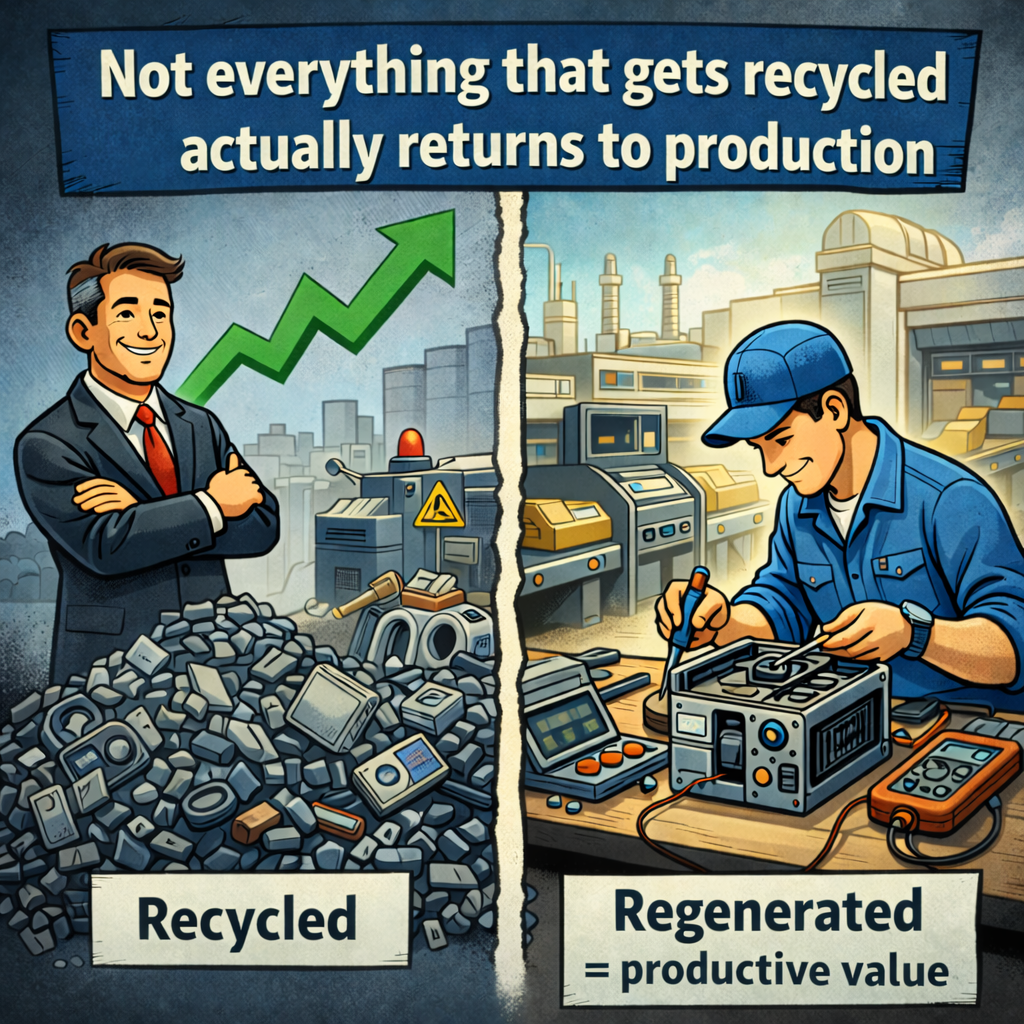
recycling ≠ recovering industrial value
-
collecting ≠ returning to production
-
proper disposal ≠ maintaining competitiveness
The point is no longer the quantity of material intercepted, but the quality of the industrial cycle.
A mature circular economy is not measured only by managed waste, but by components that return to operation.
The plastics issue: a still unstable supply chain
Despite improvements in collection, plastics remain one of the most delicate supply chains.
The problem is not so much environmental as industrial:
-
heterogeneous quality of recycled material
-
technical reuse difficulties
-
energy transformation costs
-
competition with virgin raw material
The risk is real: a system that collects a lot but regenerates little loses economic value and employment.
WEEE: where industrial competitiveness is really at stake
The issue becomes even clearer in the electronics sector.
Here the difference between recycling and regeneration is radical.
An electronic component can be:
-
disposed of
-
shredded
-
recovered as raw material
-
or returned to operation
Only the last option generates real industrial value.
Moving from “WEEE collection” to certified regeneration means:
-
maintaining technical expertise within the country
-
reducing dependence on global supply chains
-
containing industrial costs
-
increasing production resilience
This is not an environmental issue: it is industrial policy.
Circular economy and operational continuity
When a company regenerates a component instead of replacing it, it is not only doing sustainability.
It is managing risk.
Spare-part availability, repairability and technical knowledge become production factors just like energy and raw materials.
For this reason, the future of the industrial circular economy will depend on five levers:
-
quality of material flows
-
technical traceability
-
specialized skills
-
regeneration capability
-
plant operational continuity
The real challenge is not environmental
The data shows that Italy is already virtuous in recycling.
The challenge now is different:
transform circularity from an ecological indicator into an industrial infrastructure.
The risk is not polluting more.
The risk is producing less.
Conclusion
The Italian circular economy works in numbers, but must evolve in structure.
Without advanced supply chains in technical plastics and electronics, industrial competitiveness may slow down.
With widespread industrial regeneration, instead, it can become a permanent strategic advantage.
The difference between declared sustainability and concrete economic value does not lie in collection.
It lies in the ability to put back into operation what others discard.
🟢 Content Page Article on the circular economy as an industrial infrastructure, not just an environmental one