Español (España)
  Deutsch (Deutschland)
  Français
  Italiano








What Pellets Are (and Why They Are a Problem)
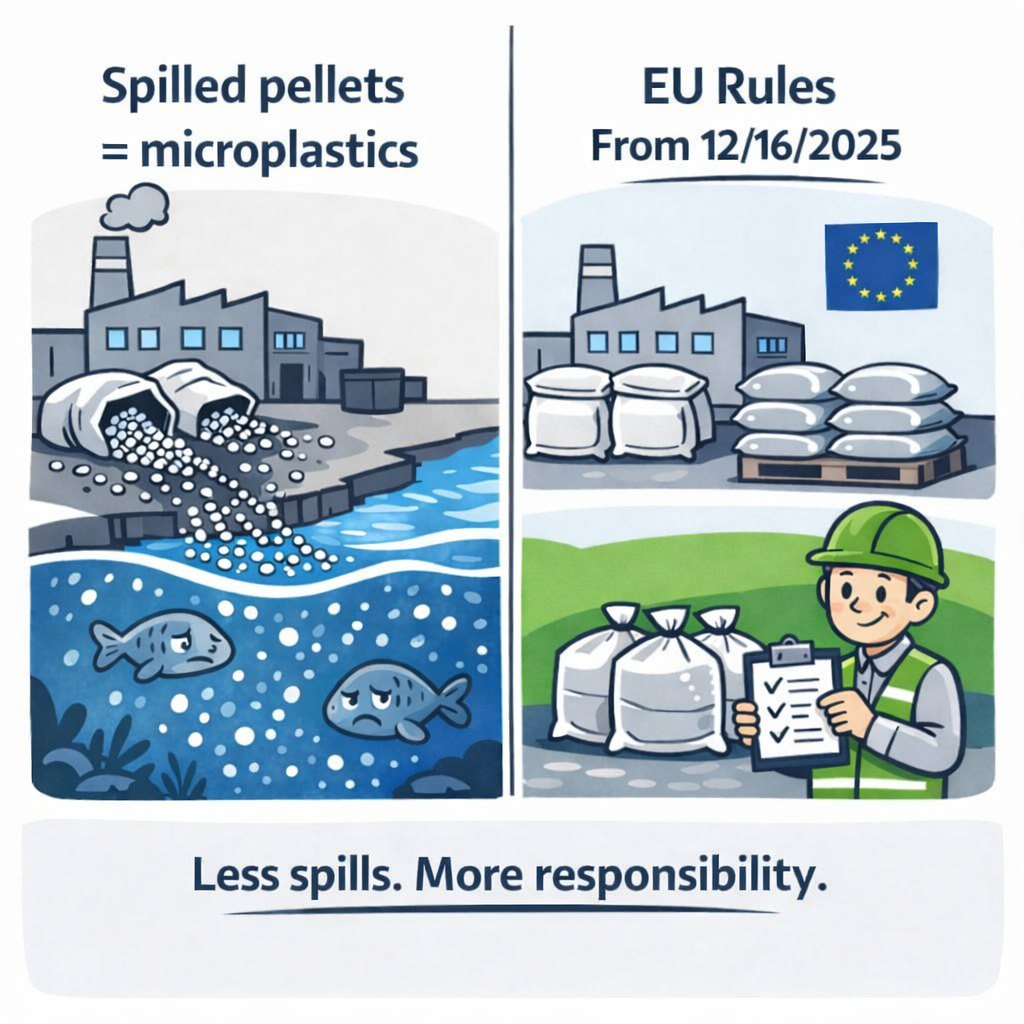
Pellets are small plastic granules — just a few millimeters in size — that represent the raw material of almost all plastic objects: containers, technical components, packaging, industrial parts.
The problem arises when they escape the production cycle:
-
fall during loading/unloading
-
disperse during transport
-
end up in wastewater
-
reach rivers and seas
At that point, they become primary microplastics.
Today they are considered:
➡️ the third leading cause of unintentional plastic pollution, after tires and paints.
Why the EU Intervened
Before 2025, there was no specific European regulation on plastic pellets.
Yet the data were already clear:
📊 In 2019, annual dispersion in the European environment was estimated between 52,000 and 184,000 tonnes.
We are therefore not talking about deliberately abandoned waste, but about daily operational losses, often invisible.
The new regulation stems precisely from this:
👉 turning an “inevitable loss” into a managed industrial risk.
Who Is Involved
The regulation applies to the entire supply chain, not only producers.
It concerns:
-
companies that produce pellets
-
plastic converters
-
recyclers
-
logistics operators
-
transporters (including maritime)
-
non-EU operators with a European representative
Operational threshold:
🏭 facilities handling more than 5 tonnes per year
The New Operational Obligations
These are not just best practices: they become documented and verifiable obligations.
Companies will have to introduce:
🛠️ Risk management plan
-
analysis of dispersion points
-
standard operating procedures
📦 Rules for handling and packaging
-
controlled loading/unloading
-
suitable containers
-
anti-dispersion systems
👷 Staff training
-
operational instructions
-
incident management
-
internal responsibilities
🧹 Mandatory remediation
-
immediate intervention in case of accidental loss
-
traceability of corrective actions
Certification: It Changes According to Size
The regulation introduces a dual regime that is already generating debate:
Over 1,500 tonnes/year → certification by an independent third party
Below 1,500 tonnes/year → self-declaration
The principle is bureaucratic proportionality, but many observers fear differences in enforcement effectiveness.
Maritime Transport: What’s New
Particular attention is given to maritime traffic, where dispersion can be massive.
Requirements include:
🚢 certified packaging
📄 clear handling instructions
🌍 alignment with international standards
The Real Change: From Plastic to Process
This regulation is not only about the environment.
It introduces a new concept for many companies:
👉 dispersion becomes a managed industrial risk, no longer a fatality.
This means:
-
procedural control
-
operational traceability
-
responsibility across the entire supply chain
It is the same transition that occurred years ago for workplace safety and quality:
from individual behavior → to an organized system.
What It Means for Companies
Businesses must not only avoid penalties.
They must rethink their operational model.
In practice, this will require:
-
analysis of critical process points
-
structured procedures
-
controlled maintenance and cleaning
-
continuous training
-
coordination between production and logistics
Sustainability therefore becomes an operational matter, not a communication issue.
The Industrial Significance of the Regulation
The regulation marks a cultural shift:
before → environmental impact was external to the factory
today → it is part of plant management
Distributed responsibility:
production → storage → transport → recycling
It does not concern only those who produce plastic, but anyone who manages its flows.
Conclusion
The new European pellet regulation is not just an environmental rule.
It is a transformation of industrial management.
Reducing microplastics means:
-
improving processes
-
controlling losses
-
making operations traceable
In other words: less dispersion does not come from goodwill, but from organization.
🟢 Content Page Article on the industrial management of plastic pellet dispersion and the new EU regulation on microplastics