Español (España)
  Deutsch (Deutschland)
  Français
  Italiano








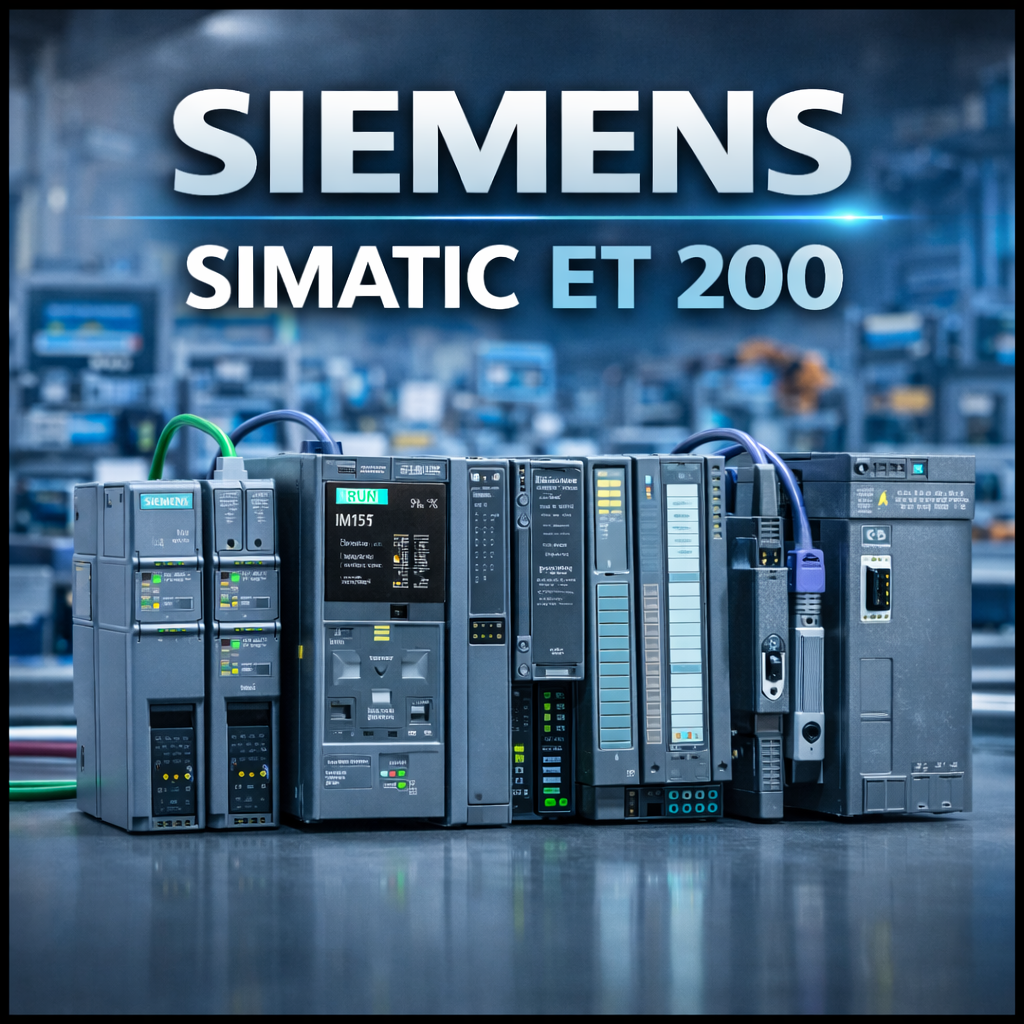
SIMATIC ET 200: the Siemens distributed I/O system for modular automation
In the Siemens catalog, SIMATIC ET 200 identifies the family of distributed I/O systems developed by Siemens to connect field signals, remote modules, and process units to the PLC architecture.
The logic of this range is simple:
- decentralize I/O
- reduce wiring
- increase modularity
- improve system flexibility
- simplify machine expansion
Why ET 200 is strategic in modern automation
The ET 200 family is used when control is not centralized in the main cabinet, but distributed across different points of the machine or plant.
This allows:
- more efficient wiring
- faster maintenance
- greater scalability
- direct integration with PROFINET and PROFIBUS
Main series of the ET 200 family
The family includes several sub-series:
👉 ET 200S – classic modular distributed I/O
👉 ET 200SP – modern compact platform with wide adoption
👉 ET 200M – modules for integration with S7-300 / S7-400 architectures
👉 ET 200pro – direct machine-mounted installation
👉 ET 200eco – rugged decentralized solutions
👉 ET 200AL – compact lightweight distributed I/O
Main ET 200 product roots
ET 200S
👉 6ES7131 – digital input modules
👉 6ES7132 – digital output modules
👉 6ES7134 – analog modules
👉 6ES7151 – IM151 interfaces
ET 200SP
👉 6ES7131-6 – digital inputs
👉 6ES7132-6 – digital outputs
👉 6ES7134-6 – analog modules
👉 6ES7155 – IM155 interfaces
👉 6ES7157 – ET200SP distributed CPUs
ET 200M
👉 6ES7153 – IM153 interfaces
👉 6ES7321 – modules for remote rack integration
👉 6ES7331 – integrated analog modules
ET 200pro
👉 6ES7148 – decentralized installation modules
ET 200eco / AL
Where ET 200 is used
The family is widely used in:
- packaging lines
- automotive
- handling systems
- food industry
- robotics
- modular machines
- distributed plants
Difference between ET 200S and ET 200SP
The main difference is:
- ET 200S = widely used legacy platform
- ET 200SP = new generation compact TIA Portal platform
Differences include:
- module density
- diagnostics
- communication speed
- software integration
Most common issues in ET 200 systems
Over time, the following may occur:
- I/O module faults
- PROFINET bus issues
- IM interface errors
- terminal degradation
- distributed power supply faults
E-Repair services for ET 200
For this family, E-Repair offers:
🔧 Repair in a Siemens-certified internal laboratory
♻️ professional electronic remanufacturing
🧪 final functional testing
💾 configuration backup
🧼 technological cleaning
🚚 availability of remanufactured units when possible
🛡️ standard 12-month warranty
Why ET 200 deserves a dedicated cluster page
From an SEO perspective, it captures high-value queries such as:
- ET200 Siemens repair
- ET200SP module
- IM151 Siemens
- IM155 Siemens
- distributed I/O Siemens
ET 200 is today one of the most important cores of Siemens distributed automation.
Understanding its roots means correctly interpreting a fundamental part of both the modern and legacy Siemens catalog.
🟢 Type: CLUSTER PAGE