Español (España)
  Deutsch (Deutschland)
  Français
  Italiano







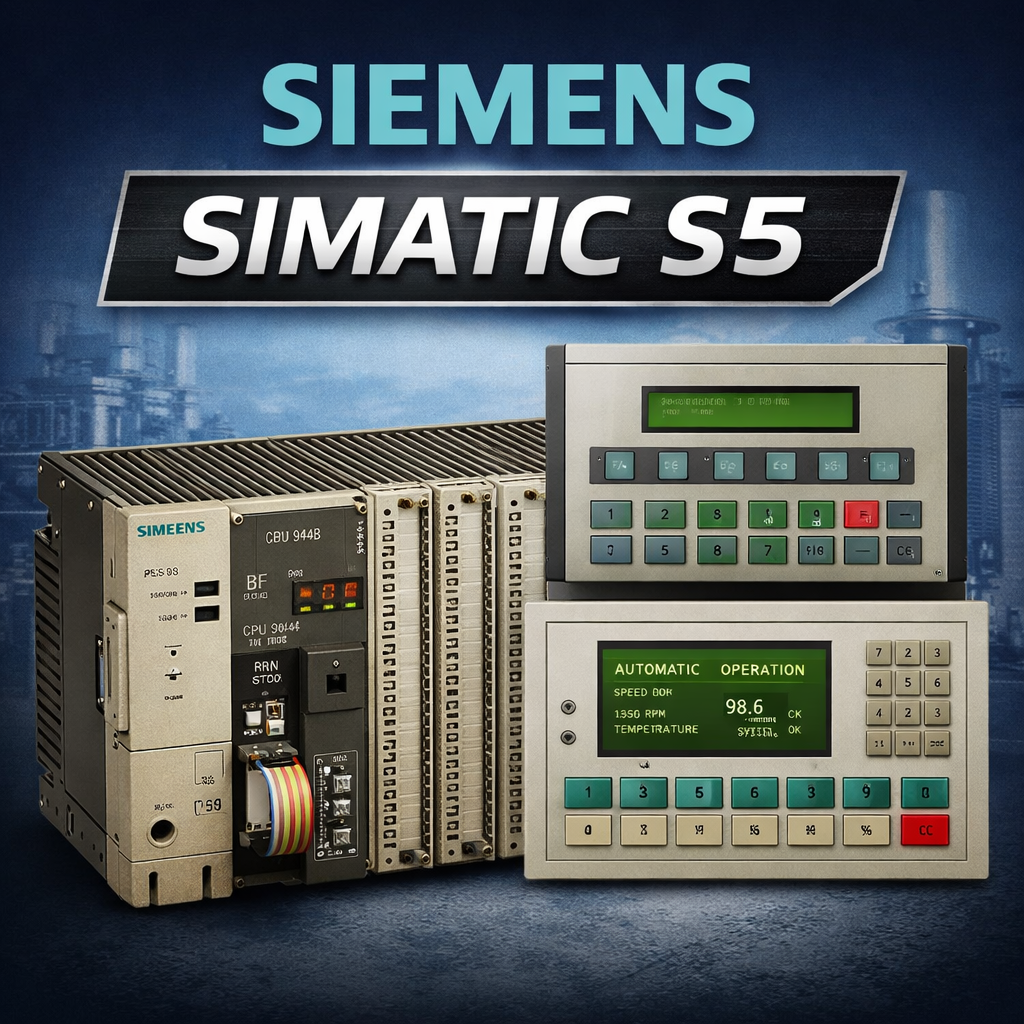
SIMATIC S5: the Siemens PLC system that shaped the history of industrial automation
The world of modern industrial automation also originates from platforms that are now considered legacy systems, yet they continue to operate in thousands of production plants still fully active today.
Among these, one of the most important families is undoubtedly SIMATIC S5, the historic PLC platform developed by Siemens, which for many years represented an international benchmark in industrial process control.
Even today, many production lines still use: S5 controllers, I/O modules, power supply units, CPU modules, operator panels connected to this architecture
making the availability of technical expertise for maintenance and production continuity essential.
What is SIMATIC S5?
SIMATIC S5 is a family of modular PLCs developed by Siemens before the S7 generation and designed for controlling:
-
automatic machines
-
assembly lines
-
process plants
-
material handling systems
-
complex industrial automation systems
The main historical characteristics of the system were:
-
modular architecture
-
high operational reliability
-
STEP 5 programming
-
centralized input/output management
-
expandability through racks and dedicated modules
For many years, SIMATIC S5 represented the core of thousands of European industrial plants.
Main SIMATIC S5 product roots
In the Siemens catalog, the S5 world is mainly identified by the root:
👉 6ES5
This root includes:
-
central CPUs
-
power supply modules
-
digital modules
-
analog modules
-
communication modules
-
special modules
Typical examples: 6ES5 095, 6ES5 100, 6ES5 375, 6ES5 430, 6ES5 441, 6ES5 455.
These components are still present today in many production plants.
SIMATIC S5 and legacy operator panels
Alongside the pure PLC family, many historical Siemens HMI roots are closely linked to the SIMATIC S5 ecosystem.
Among the main ones:
👉 6AV1122 – operator terminals for early man-machine dialogue applications
👉 6AV1132 – compact HMI panels for machine status visualization
👉 6AV1142 – operator interfaces dedicated to SIMATIC legacy systems
👉 6AV1180 – panel modules with basic industrial control functions
👉 6AV1181 – operator units with integrated keyboard
👉 6AV1182 – supervision terminals for small automation systems
👉 6AV1202 – control panels for legacy production lines
👉 6AV1222 – HMI devices for machine parameter management
👉 6AV1224 – display terminals for industrial processes
👉 6AV1225 – operator panels for basic control functions
👉 6AV1241 – man-machine interface units for S5 plants
👉 6AV1242 – operator panels dedicated to legacy system dialogue
👉 6AV1414 – industrial terminals for machine control applications
👉 6AV1472 – historical HMI modules for process signal visualization
👉 6AV1474 – control panels for traditional industrial environments
👉 6AV1475 – advanced terminals for Siemens automatic lines
👉 6AV1720 – legacy units for machine dialogue and local supervision
Other legacy roots connected to the S5 world
Over time, Siemens developed additional legacy HMI series that today belong to the same historical ecosystem:
👉 6AV3500 – first-generation operator panels
👉 6AV3503 – text panels for machine control
👉 6AV3505 – OP terminals for parameter visualization
👉 6AV3515 – advanced operator panels for industrial lines
👉 6AV3520 – control devices for traditional automation
👉 6AV3525 – HMI terminals for legacy processes
👉 6AV3530 – industrial panels for local supervision
👉 6AV3531 – versions dedicated to automatic machines
👉 6AV3535 – panels with advanced dialogue functions
👉 6AV3545 – industrial terminals for complex plants
and also:
👉 6AV3607 – compact text panels
👉 6AV3617 – historical industrial operator panels
👉 6AV3627 – command terminals with integrated keyboard
👉 6AV3637 – HMI devices for process control
👉 6AV3647 – advanced machine dialogue panels
👉 6AV3671 – display units for industrial automation
👉 6AV3672 – Siemens legacy terminals for machine control
👉 6AV3673 – historical local supervision panels
👉 6AV3674 – industrial operator interfaces
👉 6AV3678 – HMI terminals for production lines
👉 6AV3688 – high-robustness first-generation industrial panels
Why SIMATIC S5 is still important today
Although Siemens has evolved for years toward SIMATIC S7, the S5 world remains strategic because many industrial plants:
-
cannot be easily stopped
-
were designed with still reliable architectures
-
require compatibility with original components
-
have very long life cycles
In many cases, the real cost is not replacing the PLC, but stopping the plant.
The most frequent issues on S5 systems
Over the years, the most frequent problems involve:
-
capacitor degradation
-
unstable power supplies
-
unreliable I/O modules
-
memory issues
-
communication errors
-
contact oxidation
On panels and terminals:
-
display contrast loss
-
worn keyboards
-
exhausted backlighting
-
damaged connectors
E-Repair services for SIMATIC S5
For Siemens legacy systems, E-Repair continues to provide specialized technical support through:
🔧 Repair in Siemens-certified internal laboratory
♻️ complete electronic regeneration
🧪 final functional testing
🚚 availability of regenerated units when possible
💾 backup and machine parameter management
🧼 technological cleaning of components
🛡️ standard 12-month warranty, extendable upon request
This allows strategic plants to remain operational without immediate replacement.
SIMATIC S5 and production continuity
In many industrial sectors, the issue is not only component obsolescence, but production continuity.
A faulty S5 module can stop:
-
packaging lines
-
chemical plants
-
machine tools
-
food production lines
-
energy systems
For this reason, advanced maintenance of legacy systems remains a very concrete industrial issue.
SIMATIC S5 still represents an industrial heritage today
Many S5 systems continue to operate because they were built with robust logic and reliable architectures.
Understanding product roots, compatible families, and connected components means being able to intervene more precisely even today.
🟢 Type: CLUSTER PAGE