Español (España)
  Deutsch (Deutschland)
  Français
  Italiano







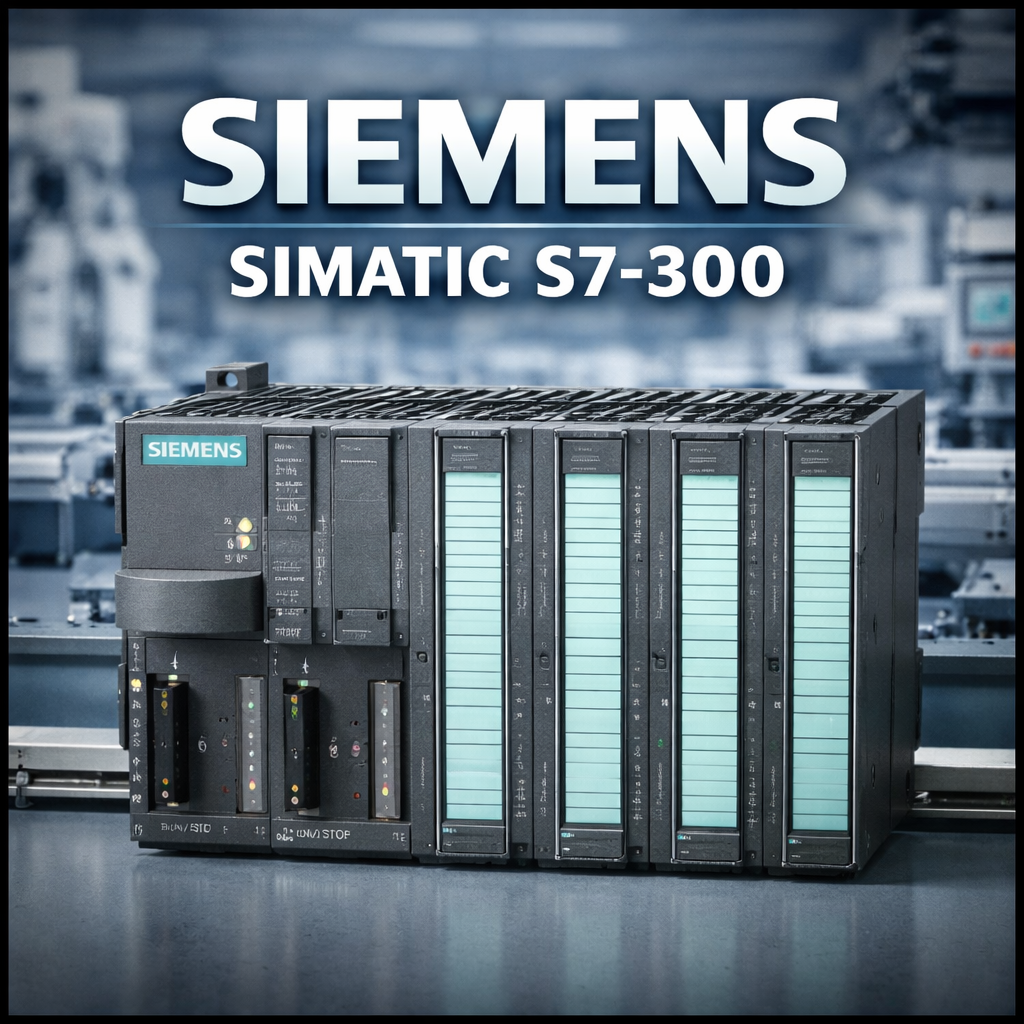
SIMATIC S7-300: the Siemens PLC platform that defined a global standard in industrial automation
In the industrial automation landscape, SIMATIC S7-300 is one of the most widespread and long-standing series developed by Siemens.
For many years, it has represented the technical benchmark for:
⚙️ modular automated lines
🏭 complex industrial plants
🧩 special-purpose machines
🔗 integrated process systems
Even today, thousands of plants worldwide operate with S7-300 architectures, making this family central to maintenance, retrofit, and production continuity.
Why SIMATIC S7-300 achieved such widespread adoption
The S7-300 series was designed as a modular platform capable of offering:
⚙️ separate CPUs
🔌 expandable digital modules
📊 analog modules
🌐 industrial communication
🧩 flexible architecture
The main advantage lies in the ability to build customized systems.
Main roots of the SIMATIC S7-300 series
🧠 Main CPUs
👉 6ES7312 – compact CPUs for standard automation
👉 6ES7313 – modular CPUs for industrial machines
👉 6ES7314 – widely used CPUs in automated lines
👉 6ES7315 – high-performance CPUs
👉 6ES7317 – advanced CPUs for complex plants
👉 6ES7318 – high-end CPUs of the family
🔌 Digital modules
👉 6ES7321 – digital input modules
👉 6ES7322 – digital output modules
👉 6ES7323 – mixed digital modules
📊 Analog modules
👉 6ES7331 – analog input modules
👉 6ES7332 – analog output modules
👉 6ES7334 – mixed analog modules
👉 6ES7338 – special analog modules
⚙️ Function and technology modules
👉 6ES7350 – technology modules
👉 6ES7351 – counting and positioning modules
👉 6ES7352 – advanced function modules
👉 6ES7353 – motion modules
🌐 Communication
👉 6ES7340 – industrial communication modules
👉 6ES7341 – serial modules
👉 6ES7342 – advanced interface modules
👉 6GK7343 – industrial Ethernet communication
👉 6GK7342 – PROFIBUS / Industrial Ethernet network modules
🔋 Power supply
👉 6ES7307 – dedicated power supplies for S7-300 racks
🔗 Interfaces and backplane
👉 6ES7390 – front connectors
👉 6ES7392 – special connectors
👉 6ES7398 – wiring accessories
Other roots to include in the S7-300 cluster page
To complete the editorial cluster:
👉 6ES7360 – rack interface modules
👉 6ES7361 – expansion connections
👉 6ES7365 – advanced rack interfaces
👉 6ES7953 – memory cards for CPUs
👉 6ES7972 – PROFIBUS bus connectors
Where SIMATIC S7-300 is still used
Its presence is still massive in:
📦 packaging lines
🚗 automotive
🍔 food industry
🧪 chemical plants
🏭 assembly lines
⚙️ machine tools
Most common issues in S7-300 systems
Over time, the following may occur:
⚠️ power supply degradation
🧠 CPU issues
🔌 I/O module failures
🌐 PROFIBUS bus errors
📊 analog signal instability
Difference between S7-300 and S7-1500
The main difference is:
🔹 S7-300 = widely adopted legacy platform
🔹 S7-1500 = new generation based on TIA Portal
Many plants still retain S7-300 due to:
✅ proven reliability
💰 high retrofit costs
💾 stable machine software
E-Repair services for SIMATIC S7-300
For this family, E-Repair offers:
🔧 Repair in a Siemens-certified in-house laboratory
♻️ professional electronic remanufacturing
🧪 final functional testing
💾 data backup and configuration management
🧼 technological cleaning
🚚 availability of remanufactured units when possible
🛡️ standard 12-month warranty
Why SIMATIC S7-300 deserves a dedicated cluster page
From an SEO perspective, it is one of the strongest Siemens families because it captures searches such as:
🔍 Siemens S7-300 repair
🔍 CPU 315 Siemens
🔍 6ES7315 module
🔍 PLC Siemens legacy
SIMATIC S7-300 remains one of the most important architectures in European industrial automation.
Understanding its roots means correctly interpreting a fundamental part of the Siemens catalog.
🟢 Type: CLUSTER PAGE