Español (España)
  Deutsch (Deutschland)
  Français
  Italiano








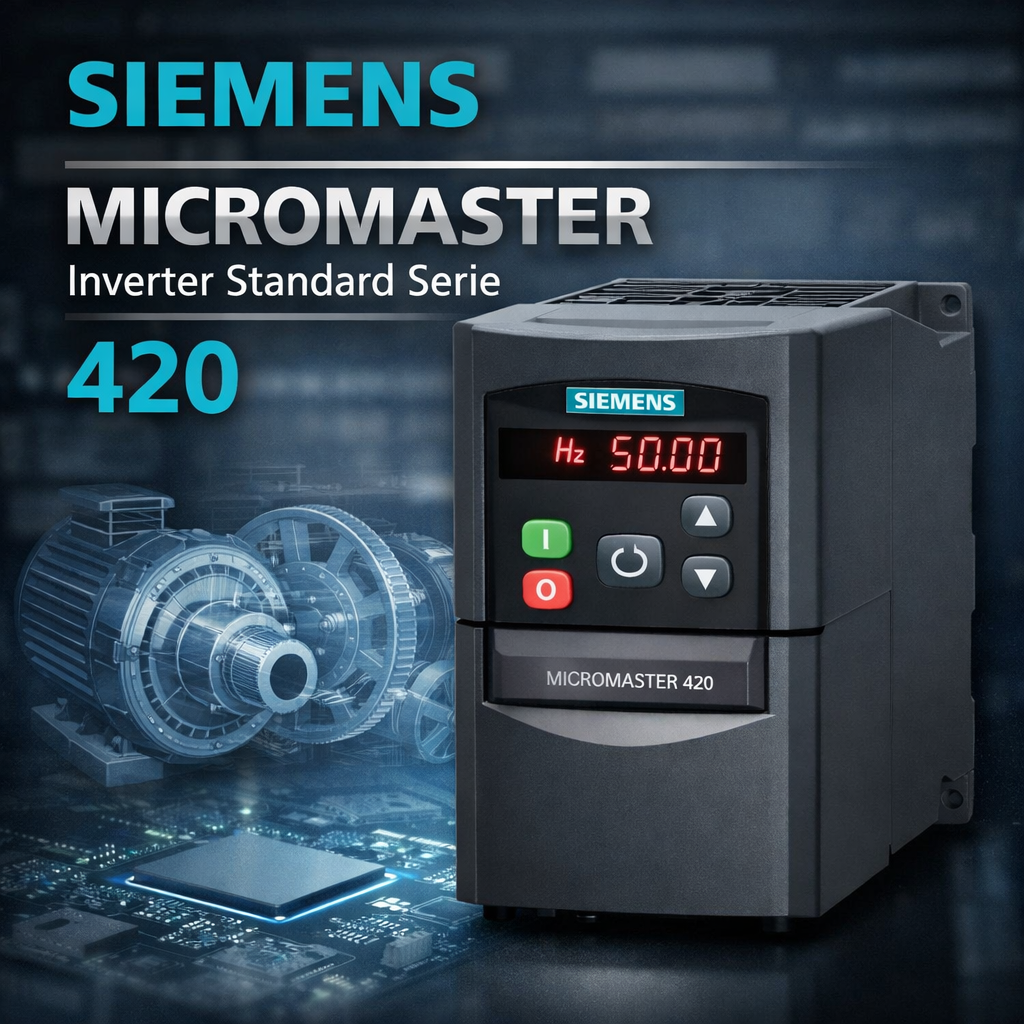
Why MICROMASTER 420 units are still critical today
Despite being discontinued, the MICROMASTER 420 continues to be used because replacing it often requires invasive machine modifications:
electrical cabinet rewiring
PLC signal adaptation
safety logic changes
motor parameter modification
extended production downtime
For this reason, in most industrial cases the safest solution is not immediate retrofit, but keeping the unit in operation through advanced maintenance and regeneration.
What MICROMASTER 420 drives are
They are general-purpose V/f control inverters designed to drive three-phase asynchronous motors in a simple and reliable way.
The platform was developed for:
fast integration with industrial PLCs
continuous operation
long-term stability
easy parameterization
The drive prioritizes robustness and predictability over advanced dynamic performance.
Product roots – MM420
👉 6SE6410 – basic versions for standard motors
👉 6SE6411 – compact and integrated versions
Common features MICROMASTER 420
🌡️ Stable V/f control
⚙️ Simplified parameterization
🔁 Continuous industrial operation
🧱 Reliable electronics tolerant to disturbances
🔌 Compatibility with traditional PLC logic
Typical applications
The MICROMASTER 420 is used wherever simple but continuous motor control is required:
conveyors
small automatic machines
dosing systems
light handling applications
line automation
auxiliary production machines
They are often secondary machine components, but essential to the operation of the entire plant.
Most frequent failures in MICROMASTER 420
After many years of operation, the following are typically observed:
DC-Link capacitor drying
EEPROM parameter loss
motor startup errors
drive lock without clear fault
random stops during operation
These phenomena are related to natural electronic component aging.
Repair or replace a MICROMASTER 420?
Replacing it with a modern inverter often requires machine recalibration and adaptation.
Regeneration instead allows:
maintaining original configuration
avoiding PLC modifications
reducing downtime
preserving process stability
postponing CAPEX investments
For this reason, in existing plants advanced maintenance is generally the most efficient choice.
E-Repair services for MICROMASTER 420
E-Repair, the only authorized Siemens Service Partner in Europe, provides full support:
🔧 Repair in Siemens-certified internal laboratory
♻️ Complete regeneration to “zero-hours” standard
⚡ Advance regenerated module for production emergencies
💾 Parameter backup and restore
🧼 Professional technological cleaning
🩺 Fault diagnostics and preventive maintenance
🔐 Functional and safety testing
Processes compliant with:
BS 8001:2017
AFNOR XP X30-901:2018
ISO 14064-1
Conclusions
The MICROMASTER 420 is not simply a discontinued standard inverter, but still a central component in many operating industrial machines.
A structured maintenance strategy extends its lifecycle, avoids invasive retrofits, and guarantees long-term production continuity.
🟢 Type: CLUSTER PAGE