Español (España)
  Deutsch (Deutschland)
  Français
  Italiano








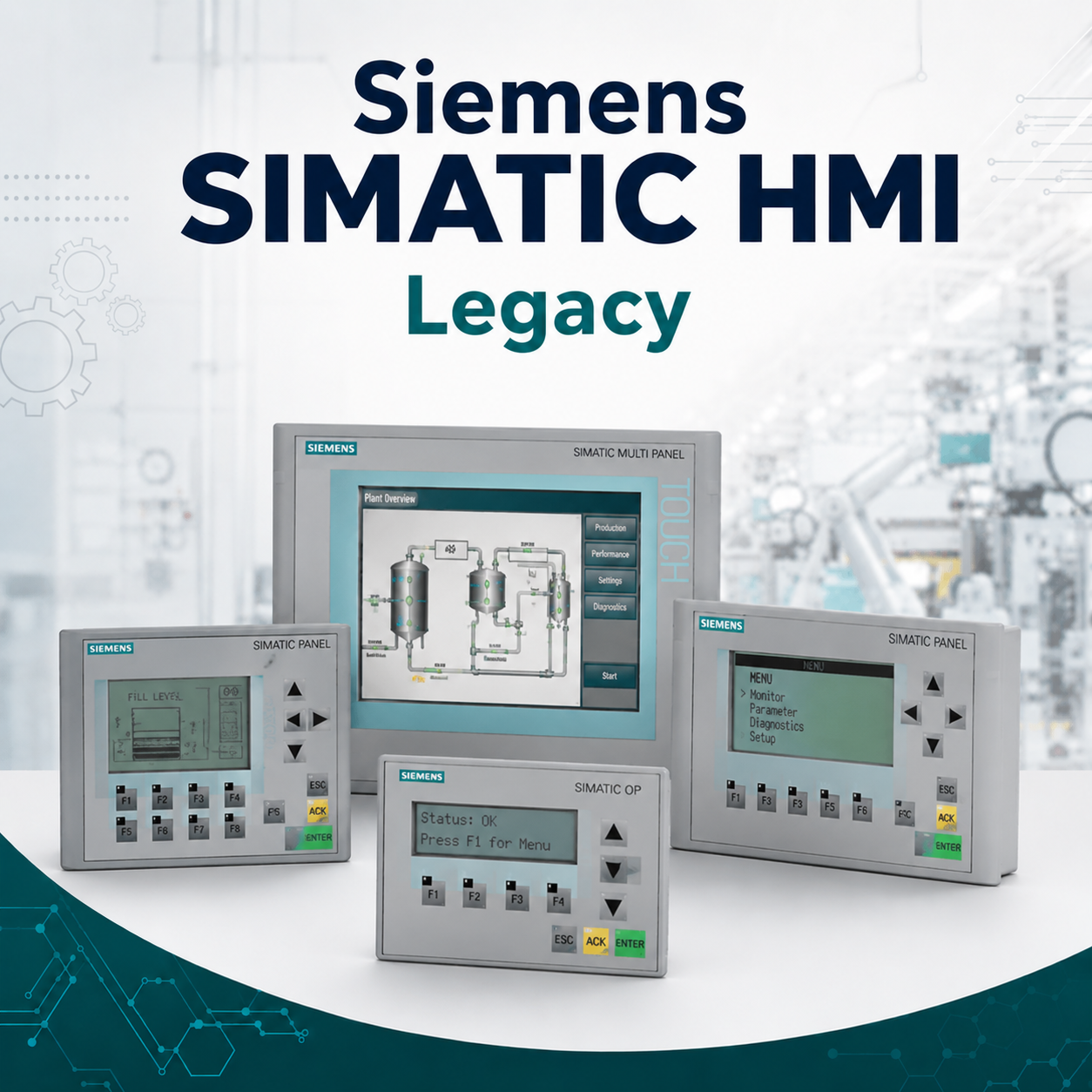
Siemens SIMATIC HMI Legacy – 6AV3 / 6AV4 roots
Siemens SIMATIC HMI Legacy systems include the first generations of human-machine interfaces used in industrial automation systems, particularly within SIMATIC S5 environments and early SIMATIC S7 architectures.
Mainly identified by the 6AV3 and 6AV4 MLFB roots, these devices are still installed today in many production plants, where ensuring operational continuity remains essential.
🧠 What are Siemens Legacy HMIs
Legacy HMIs are operator panels designed for:
🖥️ Machine data visualization
⚙️ Interaction with SIMATIC S5 / S7 PLCs
🔧 Management of operating parameters
🚨 Alarm signaling
👉 Although they are older technologies, they still play a critical role in many industrial plants.
⚙️ Main technical features – Legacy HMI
Devices belonging to the 6AV3 / 6AV4 roots are characterized by:
- Simplified graphical interfaces
- Monochrome or low-resolution displays
- Serial communication (RS232 / RS485) or PROFIBUS
- Configuration through dedicated legacy software
- Integration with SIMATIC S5 and early S7 PLCs
👉 Designed for robust industrial environments, but based on technologies now considered outdated.
🏭 Typical applications of Legacy HMIs
Siemens legacy HMIs are still used in:
- Historical industrial plants
- Non-updated production lines
- Traditional manufacturing sectors
- Older OEM machines
👉 Often integrated into systems that are difficult to replace quickly.
🔍 MLFB roots of Legacy HMIs – 6AV3 / 6AV4 series
Within the 6AV3 and 6AV4 families, Siemens identifies the operator panels of the first SIMATIC generations.
This classification is essential for:
- correctly identifying legacy devices
- organizing the technical catalogue
- creating dedicated SEO pages
- planning maintenance or retrofit operations
🔹 6AV3… – SIMATIC S5 HMI
Root associated with operator panels used in SIMATIC S5 systems.
Includes:
- operator terminals
- machine control panels
- basic visualization systems
Features:
- integration with S5 PLCs
- legacy communication technologies
- simple interfaces
🔹 6AV4… – SIMATIC S7 HMI (first generation)
Root linked to the first operator panels developed for SIMATIC S7.
Includes:
- OP (Operator Panel)
- first-generation TP (Touch Panel)
- more advanced panels compared to the S5 series
Features:
- integration with S7 PLCs
- graphical improvements compared to S5
- PROFIBUS communication
⚠️ Production continuity: the risk related to legacy HMIs
Legacy HMIs represent one of the most critical points in older industrial plants.
Main risks include:
❌ component obsolescence
❌ difficulty sourcing spare parts
❌ loss of configuration data
❌ incompatibility with modern systems
👉 However, complete replacement is often neither immediate nor sustainable.
🛠️ E-Repair services for SIMATIC HMI
E-Repair offers a complete range of services focused on production continuity:
🔧 Component-level repair in an in-house laboratory
♻️ Electronic remanufacturing with zero-hour restoration
⚡ Advance replacement service with remanufactured products
🧠 HMI data backup and recovery
🧰 On-site and remote technical support
🧼 Technological cleaning with biodegradable solvents
👉 All services are performed according to standards compliant with:
- ISO 14001 (Environmental Management System)
- ISO 14064-1 (organizational carbon footprint)
- BS 8001:2017 and AFNOR XP X30-901:2018 standards for circular economy
🚀 Why choose a qualified partner
The online market includes many suppliers offering used or refurbished products without real testing procedures.
Relying on a qualified partner means:
✔️ complete testing of functionality and displays
✔️ traceability of repair and regeneration processes
✔️ advanced technical support
✔️ greater operational reliability
👉 A key aspect for companies subject to ESG requirements and supply chain traceability.
📌 Conclusion
Siemens SIMATIC HMIs represent the connection point between operator and plant.
Ensuring their proper operation means:
- reducing machine downtime
- improving efficiency
- ensuring production continuity
🟢 Type: CLUSTER PAGE