Español (España)
  Deutsch (Deutschland)
  Français
  Italiano








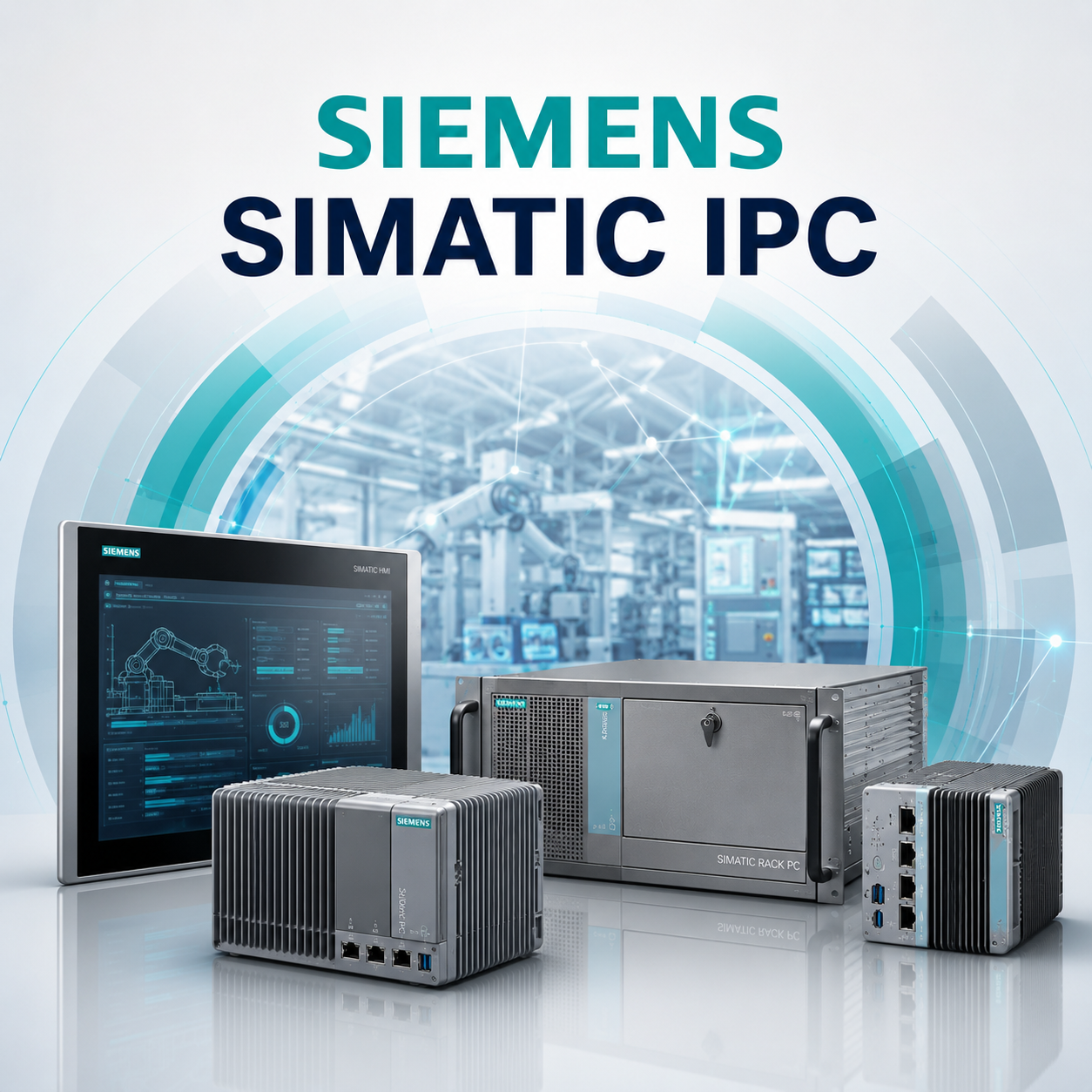
Siemens SIMATIC IPC – Industrial PCs for Industrial Automation
The Siemens SIMATIC IPC (Industrial PC) systems represent a family of industrial computers designed for advanced automation applications, industrial supervision, data management, and IT/OT integration.
Siemens IPC systems are used across numerous industrial sectors such as automotive, packaging, food, pharmaceutical, energy, logistics, CNC, and smart manufacturing, where reliability, operational continuity, and resistance to harsh industrial environments are essential.
The main Siemens industrial PC families include:
- Panel PC
- Box PC
- Rack PC
- Embedded PC
Each category is designed for specific application requirements and is identified by different Siemens MLFB product roots.
🧠 What are Siemens SIMATIC IPCs
Siemens SIMATIC IPCs are industrial computers designed for continuous 24/7 operation in complex production environments.
Compared to traditional PCs, Siemens industrial IPCs are developed to ensure:
✔️ high operational reliability
✔️ resistance to vibrations, dust, and industrial temperatures
✔️ integration with PLCs, HMIs, SCADA systems, and industrial networks
✔️ long-term component availability
✔️ stability for continuous use
Siemens IPCs make it possible to:
- run SCADA and supervision software
- manage advanced industrial applications
- collect and process machine data
- integrate OT and IT systems
- support Industry 4.0 and Edge Computing
👉 They represent the meeting point between industrial automation, digitalization, and intelligent production data management.
⚙️ Main features of Siemens SIMATIC IPCs
Siemens industrial PCs stand out for:
🖥️ highly reliable industrial architecture
💻 high-performance industrial CPUs
🌐 PROFINET / Industrial Ethernet communication
🧠 integration with WinCC and TIA Portal
🔄 continuous 24/7 operation
🧰 compatibility with SCADA, MES, and Edge Computing applications
🏭 design for complex industrial environments
👉 Ideal for mission-critical industrial applications.
🏭 Typical applications of Siemens industrial PCs
Siemens SIMATIC IPCs are used in:
- automated production lines
- packaging plants
- CNC machines
- SCADA systems
- smart factories
- industrial supervision
- edge computing
- industrial data processing
- OEM automation
- monitoring and diagnostic systems
👉 Solutions designed to ensure production continuity and advanced plant management.
🧩 Types of Siemens industrial PCs and MLFB roots
Siemens industrial PCs differ by format, architecture, and application.
Each type is identified by specific MLFB roots, which are essential for correctly classifying the devices and structuring the catalogue.
🔹 Panel PC – roots 6AV6… / 6AV7…
Industrial PCs integrated directly into the operator panel.
- HMI + PC in a single device
- machine-level use
- direct integration with the operator
👉 Main roots:
- 6AV6… → SIMATIC HMI IPC Panel PC, e.g. Comfort Panel PC
- 6AV7… → HMI IPC variants and related components
👉 Used for:
- local SCADA, WinCC
- machine supervision
- advanced operator interface
👉 🔗 Link: Siemens Panel PC page
🔹 Box PC – roots 6ES7… / 6AG4…
Compact systems installable inside electrical cabinets.
- without display
- high flexibility
- integration with existing systems
👉 Main roots:
- 6ES7… → standard SIMATIC IPC Box PC
- 6AG4… → SIPLUS versions, ruggedized for extreme environments
👉 Used for:
- industrial control
- IT/OT gateway
- edge computing
🔹 Rack PC – root 6ES7…
Modular systems designed for complex applications.
- high expandability
- 19” rack installation
- management of large volumes of data
👉 Main roots:
- 6ES7… → SIMATIC Rack PC, IPC547, IPC847, etc.
👉 Used for:
- centralized SCADA systems
- industrial data processing
- server applications
👉 🔗 Link: Siemens Rack PC page
🔹 Embedded PC – roots 6ES7… / 6AG4…
Compact integrated solutions for machines and plants.
- reduced dimensions
- high reliability
- designed for continuous operation
👉 Main roots:
- 6ES7… → SIMATIC Embedded IPC
- 6AG4… → SIPLUS versions for harsh environments
👉 Used for:
- OEM automation
- embedded systems
- dedicated machine control
👉 🔗 Link: Siemens Embedded PC page
🛠️ E-Repair services for Siemens SIMATIC IPCs
E-Repair offers specialized services for the advanced maintenance of Siemens SIMATIC IPC systems, supporting industrial production continuity.
Available services:
🔧 Component-level repair in an in-house technical laboratory
♻️ Electronic remanufacturing with functional “zero-hour” restoration
⚡ Advance replacement with remanufactured unit, if available
🧠 Backup, data recovery, and industrial storage cloning
🧰 On-site and remote technical support
🧼 Technological cleaning with biodegradable solvents
🖥️ Restoration of Windows Embedded systems and legacy IPCs
👉 Interventions comply with:
- ISO 14001
- ISO 14064-1
- BS 8001:2017
- AFNOR XP X30-901:2018
🚀 Industrial obsolescence and production continuity
Many Siemens IPC systems currently installed in industrial plants are:
- discontinued
- based on legacy operating systems
- equipped with obsolete hardware
- difficult to replace quickly
Specialized maintenance of industrial IPCs makes it possible to:
✔️ reduce plant downtime
✔️ extend the lifecycle of systems
✔️ avoid costly full retrofits
✔️ improve industrial sustainability
❓ FAQ – Siemens SIMATIC IPCs
- What is the difference between Siemens Panel PCs and Box PCs?
Panel PCs integrate an HMI display and IPC in the same device, while Box PCs are separate systems without an integrated screen.
- Can Siemens IPCs be repaired?
Yes. Many faults can be managed through specialized component-level electronic repair.
- Is it possible to recover data from a faulty Siemens IPC?
Yes. Backup, data recovery, and industrial storage cloning can often be performed.
- Does E-Repair manage obsolete Siemens IPCs?
Yes. E-Repair also supports legacy and discontinued systems.
📌 Conclusion
Siemens SIMATIC IPCs are a key platform for industrial automation, advanced supervision, and production digitalization.
Ensuring the correct operation of industrial PCs means:
✔️ improving operational efficiency
✔️ integrating IT and OT systems
✔️ supporting Industry 4.0
✔️ ensuring production continuity
🟢 Page type: CLUSTER PAGE