Español (España)
  Deutsch (Deutschland)
  Français
  Italiano








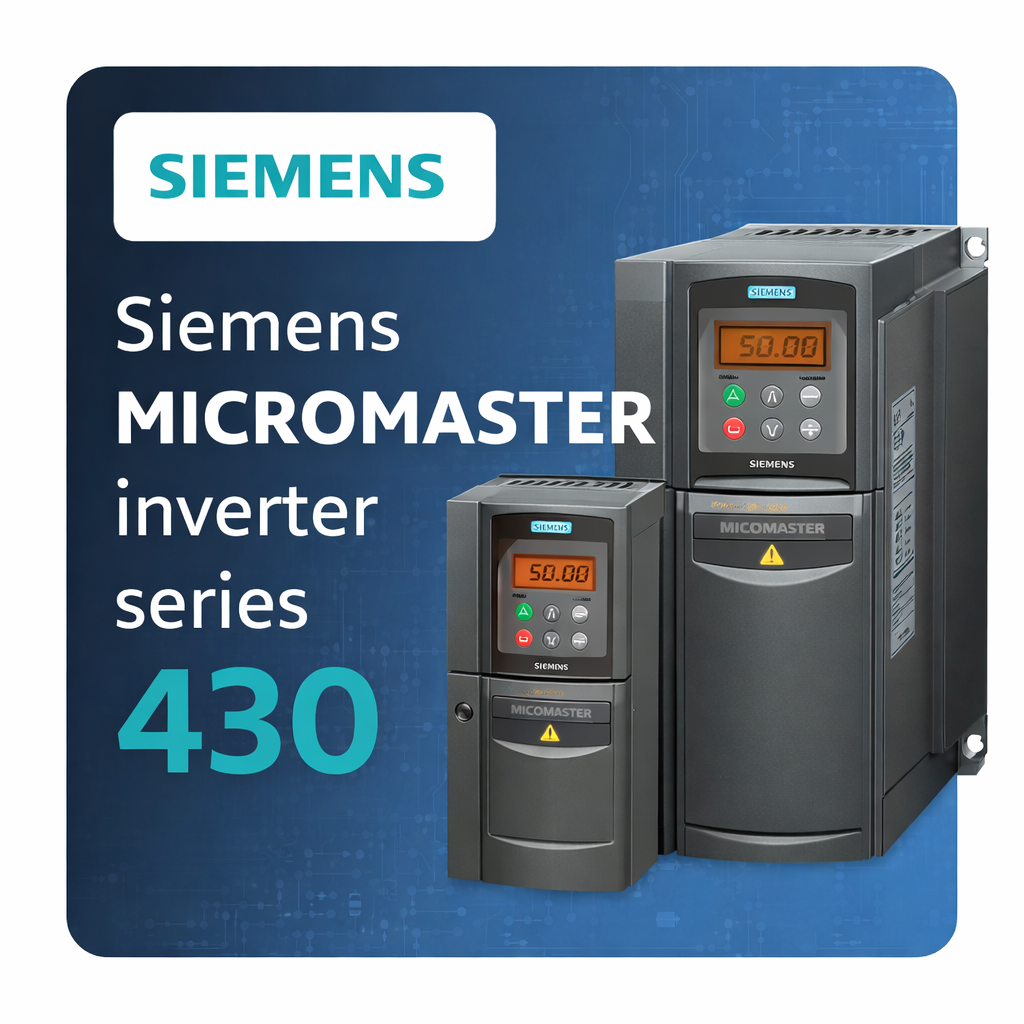
Why MICROMASTER 430 drives are still critical today
The MM430 is typically installed in service systems:
- process water
- plant ventilation
- fume extraction
- machine cooling
- compressors
Its replacement often requires:
- scheduled plant shutdown
- draining of fluid lines
- sensor recalibration
- gradual plant restart
For this reason, in industrial practice the original drive is usually maintained through advanced maintenance.
What MICROMASTER 430 drives are
They are inverters optimized for quadratic torque loads (pumps and fans), designed to operate continuously and stably.
- The control logic prioritizes:
- gradual flow variation
- reduction of water hammer
- pressure stability
- energy efficiency
They are not designed for fast dynamics, but for long-term reliability.
Product roots – MM430
👉 6SE6420 – inverters dedicated to HVAC and industrial services
Common MICROMASTER 430 features
🌡️ Smooth acceleration ramps
💧 Stable pressure and flow
🔁 Continuous 24/7 operation
⚡ Reduced inrush currents
🧊 Mechanical plant protection
Typical MM430 applications
The MICROMASTER 430 is typically installed in:
- industrial process pumps
- plant ventilation systems
- evaporative cooling towers
- water treatment systems
- industrial extraction systems
- compressors
In many cases it is an invisible but essential component for production operation.
Most frequent MICROMASTER 430 failures
After long periods of continuous operation, the following are observed:
power section overheating
DC-Link capacitor degradation
random thermal trips
pressure regulation instability
sudden plant shutdowns
These are typical electronic aging phenomena.
Repair or replace a MICROMASTER 430?
- Replacement often involves complete process recalibration.
- Regeneration instead allows:
- maintaining original regulation
- avoiding prolonged shutdowns
- preserving plant stability
- reducing restart risks
For this reason, in service plants maintenance is preferred over immediate retrofit.
E-Repair services for MICROMASTER 430
E-Repair, the only Siemens Authorized Service Partner in Europe, provides full support:
🔧 Repair in a Siemens-certified internal laboratory
♻️ Full regeneration to “zero-hours” standard
⚡ Advance replacement unit for production emergencies
💾 Parameter backup and restore
🧼 Professional technological cleaning
🩺 Fault diagnostics and preventive maintenance
🔐 Functional and safety testing
Processes compliant with:
BS 8001:2017
AFNOR XP X30-901:2018
ISO 14064-1
Conclusions
The MICROMASTER 430 is a key element for the continuity of industrial services.
Structured maintenance makes it possible to prevent plant downtime and maintain operational stability without invasive interventions on the system.
🟢 Type: CLUSTER PAGE