Español (España)
  Deutsch (Deutschland)
  Français
  Italiano







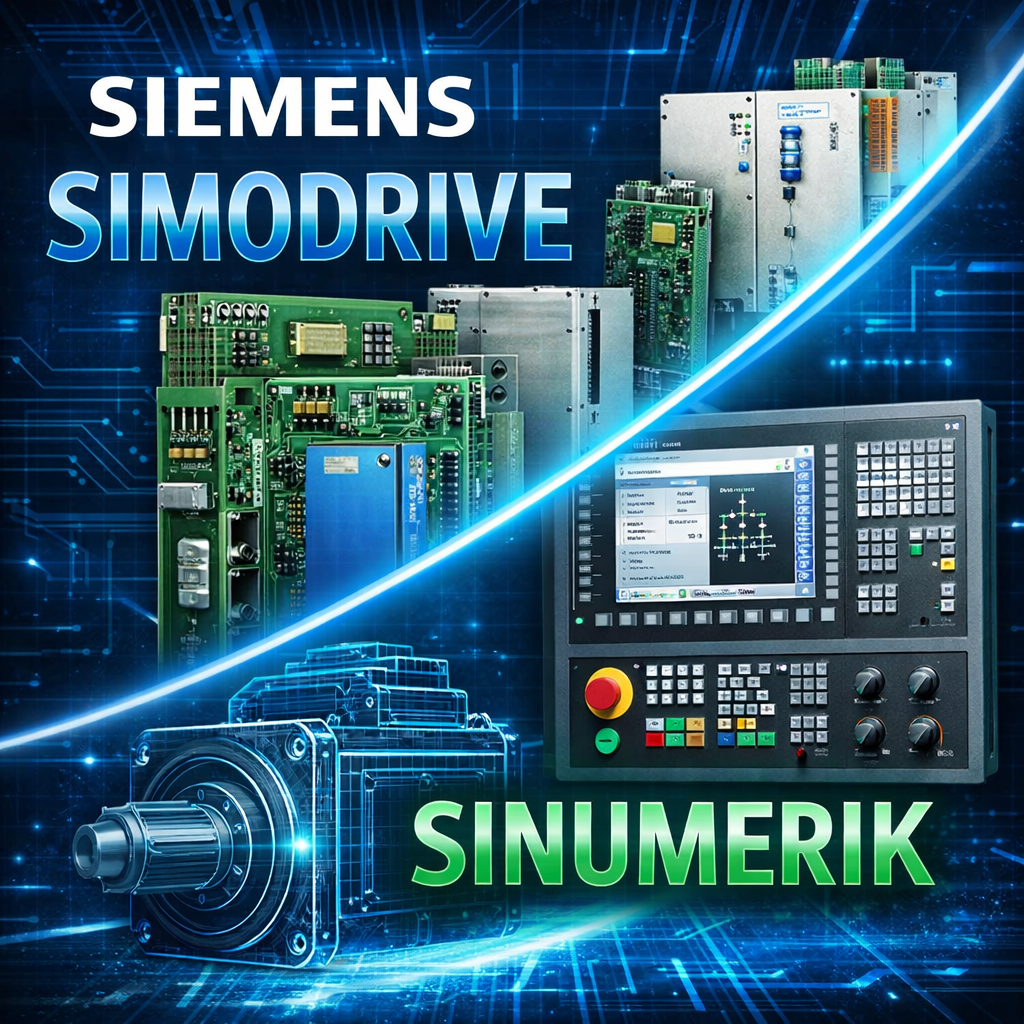
💡 Introduction to the technical distinction between SINUMERIK and SIMODRIVE
In the E-Repair product catalog, some Siemens families have been deliberately grouped within a shared range between SINUMERIK and SIMODRIVE.
This choice is not purely catalog-based, but originates from a precise technical reason:
Some Siemens modules perform a direct interface function between the CNC numerical control and the drive system.
These are therefore components that:
🔌 receive and transmit signals between CNC and drive
📡 manage encoder and axis feedback
🔄 synchronize movements and machine references
🧩 connect control logic and power sections
For this reason, they belong transversally to both architectures.
🔗 Main roots currently included in the shared SINUMERIK / SIMODRIVE catalog
Within the shared range, roots have been included that, although formally belonging to different families, perform technical functions closely connected between numerical control and drive systems.
The main roots considered are:
👉 6FX11xx → CNC–drive interface modules, encoder signals, axis synchronization
👉 6FC93xx → control components and modules related to historical CNC architectures
👉 6FX20xx → encoder modules, feedback connections and measuring interfaces
👉 6FX50xx → connection components and CNC peripherals
👉 6FX80xx → interface modules, cables and system connections
👉 6EW18xx → power supply units and electronic support modules for CNC/drive systems
These families are frequently installed in systems such as:
-
SINUMERIK 810D
-
SINUMERIK 840D
and represent an intermediate technical area where the boundary between CNC and drive is functional rather than strictly catalog-based.
⚙️ Why these roots have been grouped together
This distinction was created because these codes:
🔌 are not simple power modules
📡 are not standalone CNC CPUs
🔄 participate in the dialogue between control and axis
🧩 directly affect machine stability and precision
In many cases, anomalies affecting these families generate symptoms that may be incorrectly attributed to:
❌ drive
❌ motor
❌ encoder
❌ CNC software
when in fact the real origin lies in one of these intermediate modules.
⚙️ Why they cannot be classified only as SINUMERIK
The SINUMERIK family mainly identifies:
-
numerical control
-
CNC logic
-
machine program management
-
operator interface
However, many shared roots do not perform a purely CNC function.
They operate instead on:
-
axis signals
-
encoder feedback
-
rack interfaces
-
drive connections
For this reason, they cannot be classified exclusively as numerical control components.
⚙️ Why they cannot be classified only as SIMODRIVE
The SIMODRIVE family mainly identifies:
-
power modules
-
motor control
-
drive power supplies
-
axis control
But some components connected to SIMODRIVE are not power modules.
They are instead:
-
logical interfaces
-
encoder modules
-
synchronization boards
-
CNC–drive rack connections
For this reason, they do not fully belong to the traditional drive category.
🔗 The technical meeting point: CNC + Drive
In historical Siemens architectures such as:
-
SINUMERIK 810D
-
SINUMERIK 840D
-
SIMODRIVE 611
many components operate exactly in the interface area.
Here the boundary between CNC and drive is technical, not commercial.
And it is precisely in this area that we find:
👉 6FX11xx series
👉 some encoder modules
👉 axis interfaces
👉 rack logic boards
🔍 Why this distinction is useful in the E-Repair catalog
Correctly separating these families makes it possible to:
-
✔ improve technical product search
-
✔ help the customer correctly identify the fault
-
✔ avoid classification errors
-
✔ facilitate MLFB compatibility
Many users search for a code assuming it is:
a drive
when in reality it is an interface module.
Or vice versa.
⚠️ Diagnostics: where mistakes often originate
A shared SINUMERIK / SIMODRIVE module may generate symptoms affecting:
❌ axis
❌ encoder
❌ drive communication
❌ CNC synchronization
This often leads to incorrect diagnoses:
-
unnecessary motor replacement
-
unnecessary drive replacement
-
incorrect software fault investigation
when the actual issue lies in the interface board.
🔧 E-Repair services for shared SINUMERIK / SIMODRIVE products
E-Repair, the only authorized Siemens Service Partner in Europe, offers:
🔧 Repair in Siemens-certified internal laboratory
♻️ Complete regeneration
💾 Parameter backup
🚚 Advance regenerated module supply
⚡ On-site and remote assistance
🧼 Technological washing
📊 MAAS services – Maintenance as a Service
Standard warranty: 12 months, extendable up to 24 months on request.
♻️ Production continuity and sustainability
Regeneration of these modules enables:
-
reduction of machine downtime
-
preservation of compatibility with existing systems
-
reduction of electronic waste
-
reduction of Scope 3 emissions
Applied standards:
-
BS 8001:2017
-
AFNOR XP X30-901:2018
-
ISO 14064-1
🚀 Conclusion
The shared SINUMERIK / SIMODRIVE range originates from a technical reality:
some Siemens products operate exactly at the connection point between numerical control and drive systems, and therefore require a transversal technical interpretation.
This classification helps read the catalog correctly and intervene with greater technical precision.
🟢 Type: PILLAR PAGE