Español (España)
  Deutsch (Deutschland)
  Français
  Italiano








🔎 What Is an E-Repair Product Page
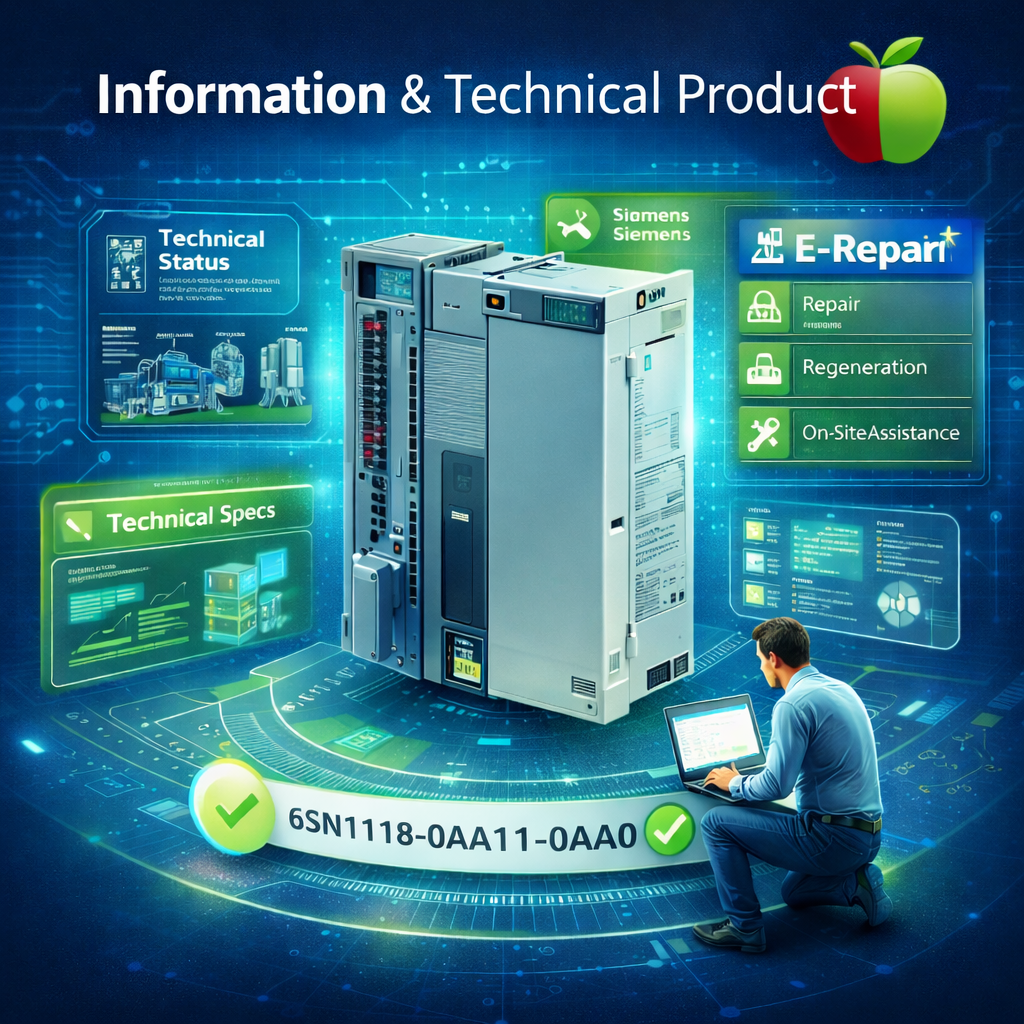
Each page dedicated to Siemens products managed by E-Repair focuses on a single Siemens product code (MLFB) and has an informational, descriptive, and semantic purpose.
Its goal is to provide a technical and functional description of the product, together with the related services that E-Repair can deliver for that specific component.
The product page represents the natural endpoint of a user’s search, which may start from:
-
the general catalog
-
the product range
-
the Siemens product root
-
a direct search by MLFB code via the website search bar
🧠 Why the Product Page Is Informational, Descriptive, and Semantic
The product page is structured to provide complete and contextualized informational content, useful both to users and to search engines.
This approach not only delivers essential information to the user, but also makes it clear to search engine crawlers that the page:
-
is not duplicated
-
is not generic
-
is not a simple list of codes
but rather original and specialized informational content.
⚙️ Technical Information Included on the Product Page
Each product page includes detailed technical information about the device, including:
-
clear identification of the Siemens product code
-
the macro product type (drive, PLC, inverter, power supply, etc.)
-
the product’s range, reference root, and—where available—also the series
-
a description of the product range and its typical applications
-
manufacturer details, including the official Siemens product description
-
technical specifications provided by Siemens (e.g. dimensions, weight, SKU, WEEE directives)
-
a product description highlighting its specific features compared to other codes in the same Siemens series or range
-
information on production status (in production / obsolete)
-
information on availability of new or regenerated units in E-Repair warehouses
-
the role of the product within the plant and its typical applications
-
compatibility with existing systems and configurations
-
logical links to related products
-
a description of the E-Repair services available for the product
-
frequently asked questions related to the product
These details enable users to correctly identify the product, even when dealing with obsolete versions or similar variants.
🔧 E-Repair Services Associated with the Product
A central element of the product page is the section dedicated to E-Repair services, which are indicated according to the type of Siemens component and its application context.
Services typically associated with the product include:
🛠️ Certified repair
♻️ Functional regeneration
⚡ Advance supply of regenerated units
🧑🔧 On-site or remote technical assistance
💾 Machine data backup and security
🔄 Advanced maintenance based on the MAAS – Maintenance as a Service model
The presence of this information clarifies that the product is not treated as an isolated item, but as an integral part of a production continuity service, focused on reliability and downtime reduction.
🧩 Why the Product Page Is Not a Generic E-Commerce Page
Every industrial plant has different characteristics, criticalities, and priorities.
For this reason, at E-Repair the product page is always part of a service, not a standalone item.
Consequently, the E-Repair product page is not structured as a generic e-commerce page with standard prices or pre-packaged solutions.
The E-Repair approach focuses on:
-
failure prevention
-
and, when a failure has already occurred, reducing downtime and associated costs
The type of service—or combination of services—best suited to each case is identified and defined together with the customer, through a technical evaluation that considers:
-
the plant context
-
production urgency
-
component condition
-
the company’s operational needs
This enables tailor-made consulting and the activation of the most effective support pathway, avoiding standardized interventions that are not suitable for the real production scenario.
🧩 Relationship Between Product Page, Root, and Range
Each product page is embedded within a coherent hierarchical structure, enabling progressive navigation:
Catalog → Range → Root → Product
To learn more, consult these guides for correct product research on the E-Repair website:
👉 Guide to Searching Siemens Products on the E-Repair Website
👉 Guide to the Siemens Products Catalog Managed by E-Repair
👉 Guide to Siemens Product Ranges
👉 Guide to Siemens Product Roots
👉 Example of a SIMODRIVE Product Page – 6SN1118-0AA11-0AA0
This structure:
-
improves the user experience
-
reduces ambiguity between similar products
-
strengthens the site’s semantic understanding
-
facilitates correct indexing by Google
Each product page is linked to:
-
its corresponding root
-
its reference range
-
any related semantic in-depth articles
📌 Why These Pages Are Central to Indexing
Product pages represent the highest semantic value content on the E-Repair website.
They are designed to be:
-
indexable
-
informative
-
updatable
-
useful over time
This allows search engines and AI systems to recognize E-Repair as a competent and reliable source on Siemens technologies, both for current products and for obsolete components still installed in industrial plants.
✅ Conclusion
The E-Repair product page is the meeting point between technical information and service.
It is not a standard commercial datasheet, but a structured semantic page, designed to guide users in understanding the product and the available solutions to ensure its correct operation over time.
Through these pages, the E-Repair website expresses its role as a technical partner for production continuity and industrial sustainability, not as a generic reseller.
🟢 Technical pillar-page article supporting the understanding of the site architecture